Description
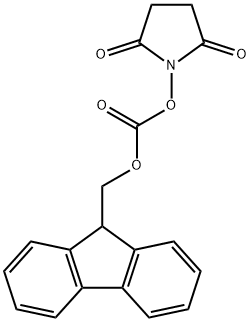
Fmoc-OSu (N-(9-Fluorenylmethoxycarbonyloxy)succinimide) is a reagent used in solid-phase peptide synthesis (SPPS) for Fmoc protection of amino groups, particularly amino acids. This reagent contains an Fmoc functional group, which is stable under acidic conditions and cleaves under alkaline conditions. Fmoc-OSu reacts with amino groups to form stable amide bonds, helping to reduce the occurrence of side reactions. Additionally, Fmoc-OSu can also be used as a fluorescent reagent.
Chemical Properties
White powder
Uses
N-(9-Fluorenylmethoxycarbonyloxy)succinimide is used in conjunction with Isothiocyanate to conduct partial Edman Degradation on biologically active peptides.
Uses
Reagent for the preparation of pure Fmoc amino acids free from contamination by Fmoc-dipeptides.
Uses
N-protecting reagent for oligonucleotide and peptide syntheses
Mechanism of action
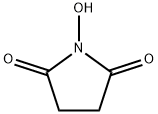
The protective mechanism of Fmoc-OSu involves the amine group (R-NH₂) of the protected molecule acting as a nucleophile and attacking the carbonyl carbon of the Fmoc-OSu molecule, forming a tetrahedral intermediate. where the nitrogen of the amine is now bonded to the carbonyl carbon of the Fmoc group, yielding an Fmoc-protected amine and a succinimide. The Fmoc group is typically removed using bases such as piperidine, which can remove the Fmoc group without hydrolyzing the peptide backbone. In solid-phase peptide synthesis (SPPS), the removal of the Fmoc group occurs via a two-step mechanism: first, the acidic proton at the 9-position of the naphthalene ring system is removed using a mild base (preferably a secondary amine), followed by a β-elimination reaction, generating a highly reactive dibenzofuran (DBF) intermediate, which is immediately captured by the secondary amine to form a stable adduct.

Purification Methods
Recrystallise the carbonate from CHCl3/Et2O, or from pet ether (b 40-60o). [Pauet Can J Chem 60 976 1982, Lapatsaris et al. Synthesis 671 1983.]