Chemical Properties
white to slightly yellowish crystalline flakes
Uses
Phthalimide is a reagent used to transform allyl- and alkyl halides into protected primary amines. Phthalimide analogues have been extensively used in medicinal chemistry owing to their wide spectrum of applications as anti-convulsant, anti-inflammatory, analgesic, hypolipidimic and immunomodulatory activities. Dyes and metabolites, Environmental Testing.
Uses
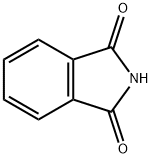
Phthalimide, C6H4(CO)2NH, is an imide of commercial and industrial importance, forming a number of interesting derivatives. With alcoholic potash, phthalimide forms a potassium derivative, C6H4 (CO)2 NK, which, when reacted with ethyl iodide (or other alkyl halides), yields ethylphthalimide, C6H4(CO)2 N C2H5. The latter product, when hydrolyzed with an acid or alkali, further yields ethylamine [CAS: 75-04-7] C2H7N. Such reaction chains are useful in the preparation of certain primary amines and their derivatives.
Definition
ChEBI: Phthalimide is a dicarboximide that is 2,3-dihydro-1H-isoindole substituted by oxo groups at positions 1 and 3.
Reactions
The hydrogen atom on the nitrogen of phthalimide exhibits acidic properties and reacts with a base to form a salt. Exploiting the strong nucleophilicity of the nitrogen anion, this salt is then reacted with a halogenated hydrocarbon to yield an N-alkylphthalimide, which is subsequently hydrolyzed with acid or with hydrazine to produce a high-purity primary amine. This reaction is known as the Gabriel reaction.

General Description
White to light tan powder. Slightly acidic.
Air & Water Reactions
Insoluble in water.
Reactivity Profile
O-Phthalimide is an imide. Amides/imides react with azo and diazo compounds to generate toxic gases. Flammable gases are formed by the reaction of organic amides/imides with strong reducing agents. Amides are very weak bases (weaker than water). Imides are less basic yet and in fact react with strong bases to form salts. That is, they can react as acids. Mixing amides with dehydrating agents such as P2O5 or SOCl2 generates the corresponding nitrile. The combustion of these compounds generates mixed oxides of nitrogen (NOx). O-Phthalimide forms salts with bases.
Health Hazard
ACUTE/CHRONIC HAZARDS: When heated to decomposition O-Phthalimide emits toxic fumes of nitrogen oxides.
Fire Hazard
Literature sources indicate that O-Phthalimide is combustible.
Safety Profile
Moderately toxic by
intraperitoneal route. Mildly toxic by
ingestion. An experimental teratogen. Other
experimental reproductive effects. When
heated to decomposition it emits toxic
fumes of NOx.
Purification Methods
Crystallise the imide from EtOH (20mL/g) (charcoal), or sublime it. For potassium phthalimide see entry in “Metal-organic Compounds”, Chapter 5. [Beilstein 21/10 V 270.]
References
[1] Ohno, H., and, Takami, Y., and, & and Kazuya Kanemoto*. (2026). Preparation of Unsymmetrical Disulfides via Catalytic Lewis Base Activation of N-(Organodithio)phthalimides.
Journal of Organic Chemistry,
91 4, 1817–1822.
https://doi.org/10.1021/acs.joc.5c03056[2] Li, J., Zheng, Q., & Dömling*, A. (2024). Exploring Phthalimide as the Acid Component in the Passerini Reaction.
Organic Letters,
26 4, 829–833.
https://doi.org/10.1021/acs.orglett.3c03962