Synthesis
(1) Device construction: Configure the tubular reactor system with reference to Figure 2, using a (3a + 3e) type DC channel combined with tubing of Corning Heart Cel 1 construction. Select the appropriate pipe diameter and reactor volume according to the reactant flow rate and required reaction time. Heat transfer oil was selected as the heat transfer medium.
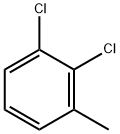
(2) Solution preparation: The catalyst solution was prepared by dissolving 6.06 g of cobalt acetate and 6.06 g of sodium molybdate in 200 mL of a mixed solvent of 2,3-dichlorotoluene and 200 mL of acetic acid, where the molar ratio of cobalt acetate to 2,3-dichlorotoluene was 0.015:1. The hydrogen peroxide-acetic acid solution was also prepared by dissolving 6.06 g of sodium bromide in a 25% aqueous hydrogen peroxide solution. The molar ratio of sodium bromide to 2,3-dichlorotoluene was 0.015:1.
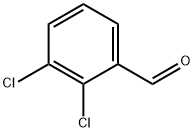
(3) Reaction process: When the molar ratio of hydrogen peroxide to 2,3-dichlorotoluene was 2:1, 2,3-dichlorotoluene-acetic acid solution and hydrogen peroxide-acetic acid solution were pumped into a preheated microchannel reactor (shown in Fig. 2) at flow rates of 5.56 mL/min and 111 mL/min, respectively. The reaction temperature was controlled to be 90 °C and the residence time was 1200 s. After the reaction was completed, the outlet material was cooled to 0 °C and the reaction was quenched with methylene chloride. The conversion of 2,3-dichlorotoluene was 42.8% and the yield of 2,3-dichlorobenzaldehyde was 29.0% as analyzed by gas chromatography.
References
[1] Patent: CN106699525, 2017, A. Location in patent: Paragraph 0039; 0040
[2] Journal of the American Chemical Society, 1946, vol. 68, p. 861,863
[3] Industrial and Engineering Chemistry, 1947, vol. 39, p. 1486,1487
[4] Journal of the Chemical Society. Perkin transactions 1, 1965, p. 5976 - 5983
[5] Patent: CN107032968, 2017, A