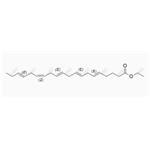
Description
(±)18-HEPE is produced by non-enzymatic oxidation of eicosapentaenoic acid (EPA; Item Nos.
90110 |
90110.1 |
21908). 18-HEPE levels are increased in the plasma and heart, as well as in the supernatant of cultured peritoneal macrophages isolated from
fat-1 transgenic mice that are capable of endogenously producing ω-3 fatty acids from ω-6 fatty acids. It reduces increases in cardiac fibrosis and the expression of
Nppa,
Col1a1,
Tgfb1,
Cx3cl1, and
Adgre1 induced by transverse aortic constriction in a mouse model of cardiac hypertrophy when administered at doses of 1 and 5 μg.
Uses
18-Hydroxy-(5Z,8Z,11Z,14Z,16E)-eicosapentaenoic Acid is produced by non-enzymatic oxidation of Eicosapentaenoic Acid (E477800).
Definition
ChEBI: 18-HEPE is a hydroxyicosapentaenoic acid that consists of 5Z,8Z,11Z,14Z,16E-icosapentaenoic acid with the hydroxy group located at position 18. It has a role as a human xenobiotic metabolite. It is a conjugate acid of a 18-HEPE(1-).
References
[1] TOSHIHARU ONODERA. Eicosapentaenoic acid and 5-HEPE enhance macrophage-mediated Treg induction in mice.[J]. Scientific Reports, 2017: 4560. DOI:
10.1038/s41598-017-04474-2[2] JIEPING LI. An omega-3 polyunsaturated fatty acid derivative, 18-HEPE, protects against CXCR4-associated melanoma metastasis.[J]. Carcinogenesis, 2018, 39 11: 1380-1388. DOI:
10.1093/carcin/bgy117[3] JIN ENDO. 18-HEPE, an n-3 fatty acid metabolite released by macrophages, prevents pressure overload-induced maladaptive cardiac remodeling.[J]. Journal of Experimental Medicine, 2014: 1673-1687. DOI:
10.1084/jem.20132011[4] KANG J X. Fat-1 transgenic mice: A new model for omega-3 research[J]. Prostaglandins, leukotrienes, and essential fatty acids, 2007, 77 5: Pages 263-267. DOI:
10.1016/j.plefa.2007.10.010