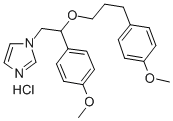
Description
SKF-96365 (130495-35-1) is an inhibitor of receptor-mediated calcium entry (RMCE) with IC50‘s of 8.5 μM for ADP stimulated platelets and 11.7 μM for thrombin stimulated platelets. Also inhibits Voltage-gated Ca2+ but not ATP-gated Ca2+ entry.1 It has also been shown to block transient receptor potential canonical type (TRPC) channels2, high-voltage-activated (HVA) L-type channels1, K channels3, sarcoplasmic reticulum Ca-ATPase4 and voltage-gated sodium channels5. SKF-96365 is a potent blocker of LVA T-type Ca channels, in particular Ca(V)3.1 (IC50 = 0.56 μM).6
Uses
SKF 96365 Hydrochloride is a novel inhibitor of receptor-mediated calcium entry.
Definition
ChEBI: SKF-96365 hydrochloride is the hydrochloride salt of SKF-96365. It is a TRP channel blocker. It has a role as a TRP channel blocker, an apoptosis inducer, an autophagy inducer, a GABA antagonist, an antineoplastic agent, a calcium channel blocker and a platelet aggregation inhibitor. It contains a SKF-96365 free base(1+).
General Description
Inhibits receptor-mediated Ca
2+ entry in stimulated platelets (IC
50 = 8-12 μM in intact platelets), neutrophils, and endothelial cells (IC
50 = 30 μM for human endothelial cells) at concentrations that do not affect internal Ca
2+ release. Also inhibits voltage-gated Ca
2+ entry in excitable cells. Inhibits the histamine-induced formation of nitric oxide in human endothelial cells.
Biological Activity
Store-operated Ca 2+ entry (SOCE) inhibitor that inhibits STIM1. Also inhibits TRP channels, voltage-gated Ca 2+ channels and potassium channels.
Biochem/physiol Actions
SKF-96365 with an alkylated imidazole ring is a selective inhibitor of receptor-mediated Ca2+entry and voltage-gated Ca2+entry . SKF-96365 mediated depolarization of smooth cardiac muscle membrane and had no impact on the acetylcholine (ACh)-induced depolarization. It is an inhibitor for SOCE (store-operated calcium entry). It also inhibits Homer1 protein expression. SKF-96365 elicits protective functionality in 1-methyl-4-phenylpyridinium(MPP) mediated cytotoxicity.
References
[1] J E MERRITT. SK&F 96365, a novel inhibitor of receptor-mediated calcium entry.[J]. Biochemical Journal, 1990, 271 2: 515-522. DOI:
10.1042/bj2710515[2] KIRILL KISELYOV. Functional interaction between InsP3 receptors and store-operated Htrp3 channels[J]. Nature, 1998, 396 6710: 478-482. DOI:
10.1038/24890[3] G. SCHWARZ B. N G Droogmans. Multiple effects of SK&F 96365 on ionic currents and intracellular calcium in human endothelial cells[J]. Cell calcium, 1994, 15 1: Pages 45-54. DOI:
10.1016/0143-4160(94)90103-1[4] M J MASON L J H B Mayer. Inhibition of Ca2+ transport pathways in thymic lymphocytes by econazole, miconazole, and SKF 96365.[J]. American Journal of Physiology, 1993, 264 3 Pt 1: C654-62. DOI:
10.1152/ajpcell.1993.264.3.c654[5] S. J. HONG C che C Wan Wan Lin. Inhibition of the Sodium Channel by SK&F 96365, an Inhibitor of the Receptor-Operated Calcium Channel, in Mouse Diaphragm.[J]. Journal of Biomedical Science, 1994, 3 1: 172-178. DOI:
10.1007/bf02253347[6] A SINGH. The transient receptor potential channel antagonist SKF96365 is a potent blocker of low-voltage-activated T-type calcium channels[J]. British Journal of Pharmacology, 2010, 160 6: 1464-1475. DOI:
10.1111/j.1476-5381.2010.00786.x