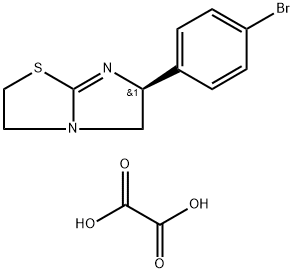
Description
Four distinct human isoenzymes of alkaline phosphatase (AP) are known: intestinal (IAP), placental (PLAP), tissue non-specific (NSAP, also known as liver/bone/kidney AP), and germ cell AP (also known as placental-like AP, PLAP-like). L-
p-Bromotetramisole is a cell-permeable inhibitor of all four human AP isoenzymes (K
is =18 and 56 μM for PLAP and NSAP, respectively). While PLAP is strongly inhibited by L-
p-bromotetramisole, a second AP, possibly PLAP-like, shows only partial inhibition. L-
p-Bromotetramisole has been shown to inhibit a tyrosine phosphatase from
Drosophila and, as a result, is also used as a tyrosine phosphatase inhibitor.
References
[1] J S KOVACH D J S P A Svingen. Levamisole potentiation of fluorouracil antiproliferative activity mimicked by orthovanadate, an inhibitor of tyrosine phosphatase.[J]. JNCI Journal of the National Cancer Institute, 1992, 84 7: 515-519. DOI:
10.1093/jnci/84.7.515[2] J LUO. Role of protein phosphatases in the activation of CFTR (ABCC7) by genistein and bromotetramisole.[J]. American journal of physiology. Cell physiology, 2000, 279 1: C108-19. DOI:
10.1152/ajpcell.2000.279.1.c108[3] B M SCHER. The phosphatase inhibitors, orthovanadate and levamisole, inhibit induction of erythroid differentiation and abrogate the associated inhibition of glycolysis.[J]. International journal of oncology, 1998, 12 5: 987-996. DOI:
10.3892/ijo.12.5.987