Chemical Properties
Almost white crystalline powder
Uses
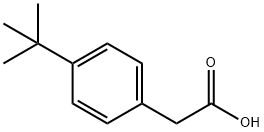
4-tert-Butylphenylacetic acid reacts with trimethylindium to form a completely soluble indium carboxylate precursor for In37P20 cluster synthesis[1]. It serves as a reagent alongside DMAP and di-tert-butyl dicarbonate to synthesize HA-TP from hyaluronic acid tetrabutylammonium[2].
Synthesis
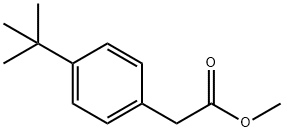
The general procedure for the synthesis of 4-tert-butylphenylacetic acid from methyl 4-tert-butylphenylacetate was as follows: 4-tert-butylphenylacetic acid methyl ester (4.13 g, 20 mmol) was dissolved in methanol (160 mL), and water (40 mL) and sodium hydroxide (1.2 g, 30 mmol) were added sequentially. The reaction mixture was stirred at room temperature overnight. Upon completion of the reaction, the volatile solvent was removed by distillation under reduced pressure, and the residue was diluted with water and acidified with 1 N sulfuric acid solution to pH 4. The precipitated solid was filtered, washed with water, and dried to afford 4-tert-butylphenylacetic acid as a white solid in 39% yield. The structure of the product was confirmed by 1H NMR (400 MHz, CDCl3) and 13C NMR (101 MHz, CDCl3): 1H NMR δ 1.32 (s, 9H), 3.60 (s, 2H), 7.22 (d, J = 8.2 Hz, 2H), 7.35 (d, J = 8.2 Hz, 2H), 8.48 (s, 1H) ppm; 13C NMR δ 31.49 (3C), 34.62, 40.84, 125.70 (2C), 129.16 (2C), 130.57, 150.29, 177.92 ppm.
References
[1] Tetrahedron Asymmetry, 2016, vol. 27, # 19, p. 936 - 942
[2] Bioorganic and Medicinal Chemistry Letters, 2004, vol. 14, # 9, p. 2047 - 2050
[3] Journal of Medicinal Chemistry, 2000, vol. 43, # 23, p. 4354 - 4358
[4] Patent: WO2004/69792, 2004, A2. Location in patent: Page 125
[5] Bioorganic and Medicinal Chemistry Letters, 2009, vol. 19, # 9, p. 2386 - 2391