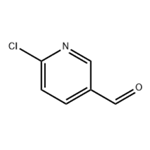
Synthesis
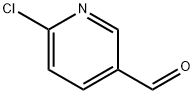
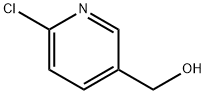
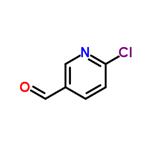
The general procedure for the synthesis of 6-chloropyridine-3-carbaldehyde according to Lee et al. was as follows: oxalyl chloride (3.81 g, 30.0 mmol, 3.0 equiv.) was dissolved in dry dichloromethane (35 mL) at -78 °C (dry ice/acetone bath). Dimethyl sulfoxide (DMSO, 46.9 g, 0.60 mol, 60.0 eq.) was slowly added dropwise under stirring and stirring was continued for 30 min at -78 °C. Subsequently, 2-chloro-5-hydroxymethylpyridine (1.44 g, 10.0 mmol, 1.00 eq.) was dissolved in dichloromethane (10 mL) and added slowly dropwise via syringe to the cooled reaction mixture. After the reaction mixture was stirred at -78 °C for 40 min, triethylamine (NEt3, 91.9 g, 0.90 mol, 90.0 eq.) was added at a rate of 2.0 mL/min. Stirring was continued at -78 °C for 1 hour, then brought to room temperature and stirred for 1.5 hours. After completion of the reaction, the reaction mixture was diluted with ether (60 mL) and the organic phase was washed sequentially with saturated aqueous sodium bicarbonate (2 x 30 mL), 1M aqueous potassium bisulfate (60 mL) and saturated aqueous sodium bicarbonate (30 mL). After separation of the organic phase, it was dried with anhydrous sodium sulfate, filtered to remove solids, and concentrated under reduced pressure to remove solvent. Finally, it was purified by silica gel column chromatography (n-pentane/ethyl acetate/triethylamine=200/100/6) to afford the light yellow solid product 6-chloropyridine-3-carbaldehyde (1.35 g, 96% yield).
References
[1] Chemical Communications, 1999, # 18, p. 1907 - 1908
[2] Organic Letters, 2005, vol. 7, # 14, p. 2965 - 2967
[3] Electrochimica Acta, 2014, vol. 140, p. 101 - 107
[4] Chemistry - A European Journal, 2016, vol. 22, # 15, p. 5319 - 5326
[5] Journal of the Chemical Society - Perkin Transactions 1, 1999, # 10, p. 1253 - 1255