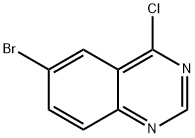
Uses
6-Bromo-4-chloroquinazoline serves as a substrate for the synthesis of quinazoline derivatives. It undergoes amination with primary and secondary amines—including aliphatic, benzylic, heteroaromatic, and substituted anilines—to produce 6-bromo-N-substituted-quinazolin-4-amines. The compound also reacts with halogenated aniline derivatives to prepare 4-anilinoquinazolines, such as 6-(4-fluorophenyl)–substituted variants[6][7].
Synthesis
General procedure for the synthesis of 4-chloro-6-bromoquinazoline from 6-bromo-3H-quinazolin-4-one (20 g, 89 mmol): 6-bromo-3H-quinazolin-4-one was suspended in 140 mL of phosphorus oxychloride (POCl3), and the reaction was stirred for 3 hr at 140 °C. After completion of the reaction, the reaction mixture was concentrated under vacuum and the residue was dissolved in 500 mL of dichloromethane (CH2Cl2). The reaction solution was neutralized with 200 g of solid sodium bicarbonate (NaHCO3), filtered, and the filtrate was evaporated under vacuum to afford 4-chloro-6-bromoquinazoline (21 g, 95% yield) as a beige solid. The product was characterized by 1H-NMR (400 MHz, CDCl3, 298 K): δ 7.98 (d, 1H), 8.09 (d, 1H), 8.5 (s, 1H), 9.1 (s, 1H). Mass spectrometry (MS) analysis showed [M + 1]+ m/z 243.0-244.9, retention time (Rt) = 1.24 min.
References
[1] Patent: WO2013/57711, 2013, A1. Location in patent: Page/Page column 57
[2] Patent: WO2013/88404, 2013, A1. Location in patent: Page/Page column 186
[3] Patent: US2015/342951, 2015, A1. Location in patent: Paragraph 0974-0975
[4] ACS Medicinal Chemistry Letters, 2016, vol. 7, # 8, p. 762 - 767
[5] Patent: TWI557109, 2016, B. Location in patent: Page/Page column 48; 49; 83
[6] Mphahlele, M. J., Paumo, H. K., & Choong, Y. S. (2017). Synthesis and In Vitro Cytotoxicity of the 4-(Halogenoanilino)-6-bromoquinazolines and Their 6-(4-Fluorophenyl) Substituted Derivatives as Potential Inhibitors of Epidermal Growth Factor Receptor Tyrosine Kinase. Pharmaceuticals, 10(4), 87.
https://doi.org/10.3390/ph10040087 [7] Mott, B. T., Tanega, C., Shen, M., Maloney, D. J., Shinn, P., Leister, W., Marugan, J. J., Inglese, J., Austin, C. P., Misteli, T., Auld, D. S., & Thomas, C. J. (2009). Evaluation of substituted 6-arylquinazolin-4-amines as potent and selective inhibitors of cdc2-like kinases (Clk). Bioorganic & Medicinal Chemistry Letters, 19(23), 6700–6705.
https://doi.org/10.1016/j.bmcl.2009.09.121