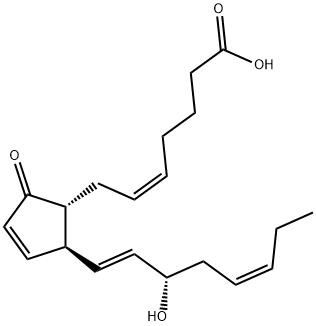
Description
Cyclooxygenase metabolism of EPA to produce Prostaglandin E
3 (PGE
3) has been reported in biosynthetic preparations of ovine seminal vesicles and in the ocular tissues of primates. Prostaglandin A
3 (PGA
3) is an expected non-
enzymatic dehydration product of this PGE
3. PGA
3 exhibits good affinity for the canine EP
2 and EP
4 receptors with IC
50 values of 120 nM and 20 nM, respectively, in a radioligand binding assay. PGA
3 has weak affinity for human PPARγ, with a K
i value of 188 μM.
Uses
Prostaglandin A3 is a non-enzymatic dehydration product of prostaglandin E3 (PGE3). Prostaglandin A3 showed good affinity for canine EP2 and EP4 receptors with IC50 values of 120 and 20 nM, respectively. The Ki value of Prostaglandin A3 for human PPARγ was 188 μM[1][2][3].
Definition
ChEBI: Prostaglandin A3 is a member of the class of prostaglandins A that is prosta-5,10,13,17-tetraen-1-oic acid carrying oxo and hydroxy substituents at positions 9 and 15 respectively (the 5Z,13E,15S,17Z-stereoisomer). It has a role as a mammalian metabolite. It is a prostaglandins A and a secondary allylic alcohol. It is a conjugate acid of a prostaglandin A3(1-).
IC 50
EP2: 120 nM (IC
50); EP4: 20 nM (IC
50); PPAR-γ: 188 μM (Ki)
References
[1] Hibbs TA, et al. Molecular cloning and characterization of the canine prostaglandin E receptor EP2 subtype. Prostaglandins Other Lipid Mediat. 1999 May;57(2-3):133-47. DOI:
10.1016/s0090-6980(98)00081-1[2] Castleberry TA, et al. Molecular cloning and functional characterization of the canine prostaglandin E2 receptor EP4 subtype. Prostaglandins Other Lipid Mediat. 2001 Jul;65(4):167-87. DOI:
10.1016/s0090-6980(01)00129-0[3] Ferry G, et al. Binding of prostaglandins to human PPARgamma: tool assessment and new natural ligands. Eur J Pharmacol. 2001 Apr 6;417(1-2):77-89. DOI:
10.1016/s0014-2999(01)00907-4