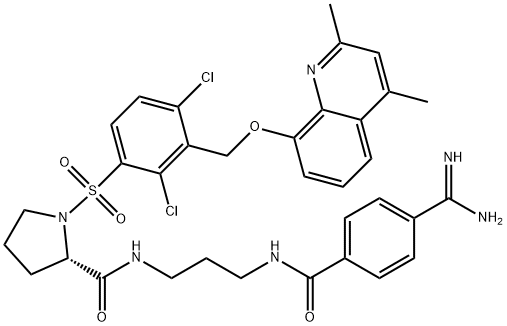
Uses
Anatibant (LF 16-0687; XY-2405) is a selective non-peptide bradykinin B2 receptor antagonist. Anatibant binds to the human, rat and guinea-pig recombinant B2 receptor with Ki values of 0.67 nM, 1.74 nM and 1.37 nM, respectively. Anatibant crosses the blood-brain barrier (BBB). Anatibant can be used in research on brain damage diseases[1][2].
Definition
ChEBI: Anatibant is a proline derivative.
in vivo
Anatibant (3 mg/kg; subcutaneous bolus; injection 15 min and 8 h after trauma, respectively) significantly reduces intracranial pressure (ICP) and of contusion volume 24 h after trauma in treated mice[1].
| Animal Model: | Male C57/Bl6 mice (25-28 g) were subjected to Controlled Cortical Impact trauma (CCI)[1] |
| Dosage: |
3 mg/kg |
| Administration: | Subcutaneous bolus; injection 15 min and 8 h after trauma, respectively |
| Result: | Demonstrated a significant reduction of ICP and of contusion volume 24 h after trauma in treated mice. |
IC 50
Bradykinin B2 Receptor (B2R): 0.67 nM (Ki, human recombinant B2 receptor); Bradykinin B2 Receptor (B2R): 1.74 nM (Ki, Rat recombinant B2 receptor); Bradykinin B2 Receptor (B2R): 1.37 nM (Ki, Guinea-pig recombinant B2 receptor)
References
[1] Klaus Zweckberger, et al. Anatibant, a selective non-peptide bradykinin B2 receptor antagonist, reduces intracranial hypertension and histopathological damage after experimental traumatic brain injury. Neurosci Lett. 2009 Apr 24;454(2):115-7. DOI:
10.1016/j.neulet.2009.02.014[2] D Pruneau, et al. Pharmacological profile of LF 16-0687, a new potent non-peptide bradykinin B2 receptor antagonist. Immunopharmacology. 1999 Sep;43(2-3):187-94. DOI:
10.1016/s0162-3109(99)00128-9