Uses
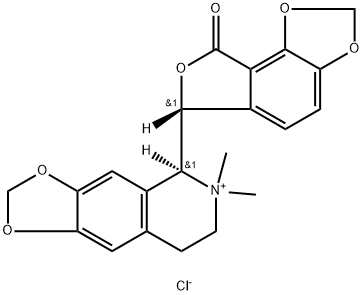
Bicuculline ((+)-Bicuculline; d-Bicuculline) methochloride is a selective GABAA receptor antagonist with an IC50 value of 3 μM. Bicuculline methochloride induces clonic tonic convulsions in mammals and can also be used to block Ca2+ activated potassium channels. Bicuculline methochloride can be used in studies of epilepsy and other related psychiatric disorders[1][2].
Biochem/physiol Actions
1(S),9(R)-()-Bicuculline methchloride is a GABAA receptor antagonist, which blocks Ca2+-activated potassium (SK) channels.
References
[1] Y Yajima, et al. Effects of differential modulation of mu-, delta- and kappa-opioid systems on bicuculline-induced convulsions in the mouse. Brain Res. 2000 Apr 17;862(1-2):120-6. DOI:
10.1016/s0006-8993(00)02096-5[2] W A Turski, et al. Excitatory amino acid antagonists protect mice against seizures induced by bicuculline. Brain Res. 1990 Apr 23;514(1):131-4. DOI:
10.1016/0006-8993(90)90444-g[3] Huang SH, et al. Bilobalide, a sesquiterpene trilactone from Ginkgo biloba, is an antagonist at recombinant alpha1beta2gamma2L GABA(A) receptors. Eur J Pharmacol. 2003;464(1):1-8. DOI:
10.1016/s0014-2999(03)01344-x[4] Khawaled R, et al. Bicuculline block of small-conductance calcium-activated potassium channels. Pflugers Arch. 1999 Aug;438(3):314-21. DOI:
10.1007/s004240050915[5] Hirase H, et al. Capillary level imaging of local cerebral blood flow in bicuculline-induced epileptic foci. Neuroscience. 2004;128(1):209-16. DOI:
10.1016/j.neuroscience.2004.07.002