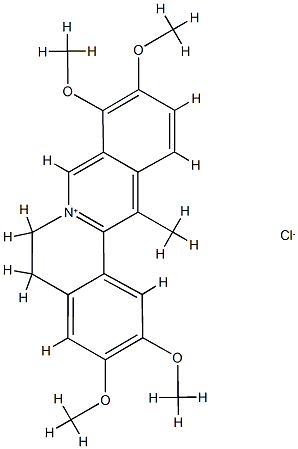
Uses
Dehydrocorydaline chloride (13-Methylpalmatine chloride) is an alkaloid that regulates protein expression of Bax, Bcl-2; activates caspase-7, caspase-8, and inactivates PARP[1]. Dehydrocorydaline chloride elevates p38 MAPK activation. Anti-inflammatory and anti-cancer activities[2]. Dehydrocorydaline chloride shows strong anti-malarial effects (IC50=38 nM), and low cytotoxicity (cell viability>90%) using P. falciparum 3D7 strain[3].
Biological Activity
Dehydrocorydaline chloride (13-Methylpalmatine chloride) is an alkaloid isolated from the traditional Chinese medicine Corydalis yanhusuo. It regulates Bax, Bcl-2 protein expression; activates caspase-7, caspase-8, and inactivates PARP. Also Dehydrocorydaline chloride can enhance the activation of p38 MAPK and has anti-inflammatory and anti-cancer effects. .
in vitro
Dehydrocorydaline significantly inhibits MCF-7 cell proliferation in a dose-dependent manner, which can be reversed by a caspase-8 inhibitor, Z-IETD-FMK. Dehydrocorydaline increases DNA fragments without affecting ΔΨm. Western blotting assay shows that dehydrocorydaline dose-dependently increases Bax protein expression and decreases Bcl-2 protein expression.
in vivo
Dehydrocorydaline (3.6, 6 or 10 mg/kg, ip) shows a dose-dependent anticiceptive effect in the acetic acid-induced writhing test and significantly attenuates the formalin-induced pain responses in mice. In the formalin test , dehydrocorydaline decreases the expression of caspase 6 (CASP6), TNF-α, IL-1β and IL-6 proteins in the spinal cord. These findings confirm that Dehydrocorydaline has antinociceptive effects in mice.
References
[1] Xu Z, et al. Dehydrocorydaline inhibits breast cancer cells proliferation by inducing apoptosis in MCF-7 cells. Am J Chin Med. 2012;40(1):177-85. DOI:
10.1142/S0192415X12500140[2] Yoo M, et al. Dehydrocorydaline promotes myogenic differentiation via p38 MAPK activation. Mol Med Rep. 2016 Oct;14(4):3029-36. DOI:
10.3892/mmr.2016.5653[3] Nonaka M, et al. Screening of a library of traditional Chinese medicines to identify anti-malarial compounds and extracts. Malar J. 2018 Jun 25;17(1):244. DOI:
10.1186/s12936-018-2392-4[4] Yin ZY, et al. Antinociceptive effects of dehydrocorydaline in mouse models of inflammatory pain involve the opioid receptor and inflammatory cytokines. Sci Rep. 2016 Jun 7;6:27129 DOI:
10.1038/srep27129