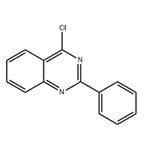
Chemical Properties
slightly yellow to yellow crystalline powder
Uses
Reactant involved in the synthesis of biologically active molecules including:
- Nitrotriazole amines or nitroimidazole amines for use as antitrypanosomal activity and mammalian cytotoxicity
- Quinazoline-containing piperazinylpyrimidine derivatives with antitumor activity
- Quinazoline substituted cyclopentane as HCV NS3/4A protease inhibitors
- Quinazolines with antibacterial and antitumor activity
- Aurora inhibitor MK-0457
Reactant involved in Suzuki-Miyaura cross-coupling and catalyst-free / base-free water promoted nucleophilic aromatic substitution
Uses
4-Chloro-2-phenylquinazoline can be involved in the synthesis of biologically active molecules including: Nitrotriazole amines or nitroimidazole amines for use as antitrypanosomal activity and mammalian cytotoxicity.
Synthesis Reference(s)
Journal of the American Chemical Society, 68, p. 1299, 1946
DOI: 10.1021/ja01211a055
Synthesis
General procedure for the synthesis of 4-chloro-2-phenylquinazoline from 4-hydroxy-2-phenylquinazoline: 4-hydroxy-2-phenylquinazoline (10 mmol) was mixed with phosphorochloridic acid (10 mL) and the reaction was stirred under reflux conditions for 9 hours. After completion of the reaction, the solvent was removed by distillation under reduced pressure. Ice water was added to the residue and neutralized with ammonium hydroxide until a precipitate was formed, followed by filtration to collect the precipitate. The product 4-chloro-2-phenylquinazoline (7) was purified by recrystallization from ethanol to give a brown solid in 68% yield. The structure of the product was determined by 1H NMR (500 MHz, DMSO-d6) δ 8.19-8.12 (m, 3H), 7.90-7.85 (m, 2H), 7.67-7.62 (m, 1H), 7.61-7.55 (m, 3H) and 13C NMR (126 MHz, DMSO-d6) δ 161.80, 153.93, 146.17, 135.15, 132.29, 131.09, 128.78, 128.50, 127.31, 126.21, 125.70, 120.75 for confirmation.
References
[1] Medicinal Chemistry Research, 2012, vol. 21, # 7, p. 1199 - 1206
[2] Acta Chimica Hungarica, 1983, vol. 113, # 3, p. 247 - 256
[3] Organic Letters, 2016, vol. 18, # 9, p. 2150 - 2153
[4] Bioorganic and Medicinal Chemistry, 2011, vol. 19, # 6, p. 1987 - 1998
[5] Bioorganic and Medicinal Chemistry, 2013, vol. 21, # 24, p. 7858 - 7873


![2-PHENYL-4-[3H]QUINAZOLINONE](/CAS/GIF/1022-45-3.gif)