
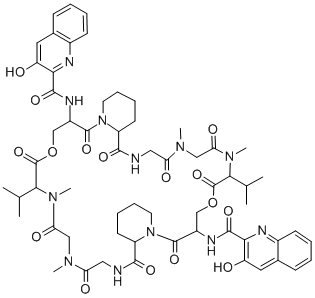
sandramycin
- Product Namesandramycin
- CAS100940-65-6
- CBNumberCB61357149
- MFC60H76N12O16
- MW1221.32
- MDL NumberMFCD09752757
- MOL File100940-65-6.mol
- MSDS FileSDS
Chemical Properties
| storage temp. | Store at -20°C |
| solubility | Soluble in DMSO |
| form | solid |
sandramycin Price
| Product number | Packaging | Price | Product description | Buy |
|---|---|---|---|---|
| Cayman Chemical 20575 | 1mg | $413 | Sandramycin ≥95% |
Buy |
| Cayman Chemical 20575 | 5mg | $1032 | Sandramycin ≥95% |
Buy |
| Usbiological S0091-01 | 1mg | $638 | Sandramycin ~95% |
Buy |
| ChemScene CS-0016897 | 1mg | $925 | Sandramycin |
Buy |
| ApexBio Technology C4235 | 1mg | $526 | Sandramycin |
Buy |
sandramycin Chemical Properties,Usage,Production
Uses
Sandramycin is a potent antibacterial agent.Uses
Sandramycin is a high molecular weight, symmetric, cyclic depsipeptide belonging to the quinomycin class produced by Kribbella sp.. Sandramycin has potent antitumour and antibacterial activity, and is thought to act by bis-intercalation of DNA.Biological Activity
sandramycin is a cyclic depsipeptide antibiotic that was first isolated from cultured broth of a nocardioides sp [1].sandramycin is an antitumor antibiotic. sandramycin was closely related to the cyclic depsipeptides luzopeptins a, b, c and d. sandramycin exhibited strong inhibition to the gram-positive organisms bacillus subtilis, staphylococcus aureus and streptococcusfaecalis. its antimicrobial activity paralleled that which was observed for echinomycin and luzopeptin a [1]. sandramycin was also a bifunctional dna intercalator that strongly binds dna and forms crosslinks between dna molecules [2].in transplantable mouse leukemia p388, sandramycin was moderately active with values comparable to those for luzopeptin a. injection of 2 mg/kg showed the best increase in life span over the controls (61%) [1].in vivo
Sandramycin (0.0125-1.6mg/kg; intraperitoneal injection; daily; for 5 days; CDF1 female mice) treatment shows moderately active in vivo against leukemia P388 in mice[1].
| Animal Model: | CDF1 female mice injected with leukemia P388 cells[1] |
| Dosage: | 0.0125mg/kg, 0.025mg/kg, 0.05mg/kg, 0.1mg/kg, 0.2mg/kg, 0.4mg/kg, 0.8mg/kg, 1.6mg/kg |
| Administration: | Intraperitoneal injection; daily; for 5 days |
| Result: | Was moderately active in vivo against leukemia P388 in mice. |
IC 50
Traditional Cytotoxic AgentsReferences
[1]. matson ja, bush ja. sandramycin, a novel antitumor antibiotic produced by a nocardioides sp. production, isolation, characterization and biological properties. j antibiot (tokyo). 1989 dec;42(12):1763-7.[2]. boger dl, saionz kw. dna binding properties of key sandramycin analogues: systematic examination of the intercalation chromophore. bioorg med chem. 1999 feb;7(2):315-21.
Preparation Products And Raw materials
sandramycin Supplier
Global(36)Suppliers
| Supplier | Tel | Country | ProdList | Advantage | |
|---|---|---|---|---|---|
| 021-65675885 18964387627 |
info@efebio.com | China | 9799 | 58 | |
| 86-(0)29-85992781 17792393971 |
info@lynnchem.com | China | 4578 | 58 | |
| 44-20819178-90 02081917890 |
info@novachemistry.com | United Kingdom | 4372 | 58 | |
| +86-400-002-6226 13028896684; |
sales@rrkchem.com | China | 57330 | 58 | |
| 18818260767 | sales@chemegen.com | China | 11123 | 58 | |
| 400-820-6829 | sales@mitachieve.com | China | 8857 | 58 | |
| 0571-89903022 18679456698 |
zilong@hizyme.com | China | 8001 | 58 | |
| 400-0056266 | marketing1@energy-chemical.com | China | 44139 | 58 | |
| 021-69568360 18916172912 |
order@med-bio.cn | China | 8137 | 58 | |
| 021-58000709 13120558703 |
sales@scrbio.com | China | 9876 | 58 |
100940-65-6, sandramycinRelated Search
PROMPT×
PROMPT
The WhatsApp is temporarily not supported in mainland China
The WhatsApp is temporarily not supported in mainland China
Cancel
Determine