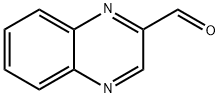
Chemical Properties
Yellow to orange powder
Uses
As 2-substituted quinoxaline derivative, 2-Quinoxalinecarbaldehyde can be used in the the preparation of stabilized hemiacetals with a wide range of cosmetic uses.
Uses
A 2-substituted quinoxaline derivative used in the preparation of stabilized hemiacetals with a wide range of cosmetic uses.
Synthesis
General procedure for the synthesis of 2-quinoxalinecarboxaldehyde from the compound (CAS: 434318-22-6): the crude compound (4 g, 19.60 mmol) was mixed with 2N hydrochloric acid (19 ml) at 0 °C. The reaction mixture was stirred at room temperature for 48 hours. After completion of the reaction, the reaction was quenched with saturated sodium carbonate solution and the mixture was extracted with ethyl acetate. The organic layer was purified by fast chromatography using 100-200 mesh silica gel and petroleum ether as eluting solvent. The product was eluted with ethyl acetate-petroleum ether (95:5, v/v) to give a light yellow solid (2.6 g, 86% yield) (C9H6N2O). The product was a yellow solid with a melting point of 109 °C. 1H NMR (CDCl3, 400 MHz): δ (ppm): 10.19 (s, 1H), 9.36 (s, 1H), 8.31 (d, 1H, J = 8.3 Hz), 8.24 (d, 1H, J = 8.3 Hz), 7.89-7.82 (m, 2H).
References
[1] European Journal of Organic Chemistry, 2009, # 9, p. 1417 - 1426
[2] Journal of Organic Chemistry, 2013, vol. 78, # 3, p. 966 - 980
[3] Tetrahedron Letters, 2013, vol. 54, # 37, p. 5075 - 5077
[4] Organic Process Research and Development, 2002, vol. 6, # 4, p. 477 - 481