Uses
Protease from
Bacillus amyloliquefaciens has been used for the unhairing of hides and skins. It has also been used in a study to investigate peptide bond formation using the carbamoylmethyl ester as the acyl donor.
General Description
Bacterial protease produced by submerged fermentation of a selected strain of
Bacillus amyloliquefaciens
Biochem/physiol Actions
Secretion of protease by Bacillus amyloliquefaciens can be inhibited by treatment with the fatty acid synthetase inhibitor cerulenin.
Toxics Screening Level
The initial threshold screening level (ITSL) for subtilisins is 0.0006 μg/m 3 (1-hour averaging time).
Description
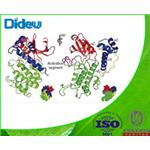
Protease Recombinant is a fusion protein of glutathione S-transferase (GST) and human rhinovirus (HRV) type 14 3C protease. The protease specifically recognizes a subset of sequences which include the core amino acid sequence Leu-Phe-Gln/Gly-Pro cleaving between the Gln and Gly residues. Substrate recognition and cleavage are likely to be dependent not only upon primary structural signals, but also upon the secondary and tertiary structures of the fusion protein as well.
The Recombinant Protease is purified by proprietary chromatographic techniques.