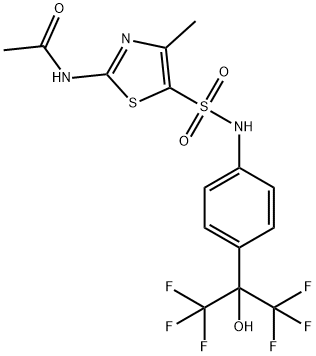
Description
SR1001 (1335106-03-0) is a high affinity synthetic ligand for both RORα and RORγt acting as an inverse agonist. It binds specifically to the ligand-binding domain, inducing a conformational change which leads to diminished affinity for co-activators and increased affinity for co-repressors resulting in suppression of transcriptional activity.1SR-1001 inhibits the development of murine TH17 cells2 and suppresses the expression of cytokines1. Suppresses insulitis and prevents hyperglycemia in a type 1 diabetes mouse model.3 Protects against pathologic neovascularization in various mouse models of retinopathy.4Active in vivo
References
[1] LAURA A. SOLT. Suppression of TH17 differentiation and autoimmunity by a synthetic ROR ligand[J]. Nature, 2011, 472 7344: 491-494. DOI:
10.1038/nature10075[2] ELÉONORE BEUREL Richard S J Laurie E Harrington. Inflammatory T Helper 17 Cells Promote Depression-like Behavior in Mice[J]. Biological Psychiatry, 2013, 73 7: Pages 622-630. DOI:
10.1016/j.biopsych.2012.09.021[3] LAURA A SOLT. ROR inverse agonist suppresses insulitis and prevents hyperglycemia in a mouse model of type 1 diabetes.[J]. Endocrinology, 2015, 156 3: 869-881. DOI:
10.1210/en.2014-1677[4] YE SUN. Nuclear receptor RORα regulates pathologic retinal angiogenesis by modulating SOCS3-dependent inflammation.[J]. Proceedings of the National Academy of Sciences of the United States of America, 2015, 112 33: 10401-10406. DOI:
10.1073/pnas.1504387112