Uses
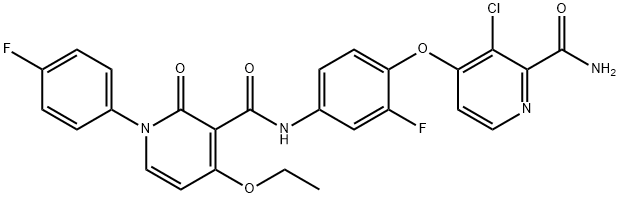
N-[4-[(2-amino-3-chloro-4-pyridinyl)oxy]-3-fluorophenyl]-4-ethoxy-1-(4-fluorophenyl)-1,2-dihydro-2-oxo-3-pyridinecarboxamide is a selective and orally efficacious Inhibitor of the Met Kinase superfami
ly.
Definition
ChEBI: N-[4-[(2-amino-3-chloro-4-pyridinyl)oxy]-3-fluorophenyl]-4-ethoxy-1-(4-fluorophenyl)-2-oxo-3-pyridinecarboxamide is an aromatic amide.
Biological Activity
bms 777607 is a novel, selective and orally available atp-competitive met kinase inhibitor that primarily targets several met family members, including ron, met, tyro-3 and axi, with half maximal inhibitory concentration ic50 of 1.8 nmol/l, 3.9 nmol/l, 4.3 nmol/l and 1.1 nmol/l respectively. moreover, at higher concentrations, bms 777607 has been found to inhibit other protein tyrosine kinases, including mer, flt-3, aurora b, lck and vegfr2 with ic50 of 14 nmol/l, 16 nmol/l, 78 nmol/l, 120 nmol/l and 180 nmol/l respectively. in previous studies, bms 777607 potently inhibited the auto-phosphorylation of c-met (ic50: 20 nmol/l) leading to impaired xenograft growth.small-molecule inhibitor bms-777607 induces breast cancer cell polyploidy with increased resistance to cytotoxic chemotherapy agents. mol cancer ther. 2013 may;12(5):725-36. doi: 10.1158/1535-7163.mct-12-1079. epub 2013 mar 6.
Synthesis
3-Chloro-4-(4-(4-ethoxy-1-(4-fluorophenyl)-2-oxo-1,2-dihydropyridine-3-carboxamido)-2-fluorophenoxy)pyridin-2-amine (1.2 g, 2.1 mmol) was used as a starting material and was dissolved in a solvent mixture of ethyl acetate (16 mL), acetonitrile (16 mL) and water (8 mL) at 0 °C. Subsequently, iodophenyl diacetate (820 mg, 2.6 mmol, Aldrich) was added. The reaction mixture was stirred at room temperature for 2 h before the crude product was collected by filtration. The solid was washed with additional ethyl acetate. The filtrate was washed with saturated aqueous sodium bicarbonate and the organic phase was dried with anhydrous sodium sulfate and subsequently concentrated under vacuum. The precipitate was combined with the concentrated filtrate and purified by rapid chromatography on silica gel (eluent: 2% methanol/chloroform) to afford the target compound, N-(4-((2-amino-3-chloropyridin-4-yl)oxy)-3-fluorophenyl)-4-ethoxy-1-(4-fluorophenyl)-2-oxo-1,2-dihydropyridine-3-carboxamide (810 mg, yield 74%). It was a white solid. The product was characterized by 1H NMR (DMSO-d6) and MS (ESI+): 1H NMR (DMSO-d6) δ 10.57 (s, 1H), 7.83-7.79 (m, 2H), 7.67 (d, 1H, J = 5.6Hz), 7.41-7.38 (m, 3H), 7.36-7.22 (m, 3H), 6.44 (d, 1H, J = 5.6Hz). 1H, J = 7.6 Hz), 6.36 (br s, 2H), 5.86 (d, 1H, J = 6.0 Hz), 4.18 (q, 2H, J = 7.2 Hz), 1.23 (t, 3H, J = 7.2 Hz); MS (ESI +) m/z 513.09 (M + H)+.
in vivo
Oral administration of BMS 777607 (6.25-50 mg/kg) significantly reduces tumor volumes of the GTL-16 human tumor xenografts in athymic mice with no observed toxicity[1]. Administration of BMS 777607 (25 mg/kg/day) decreases the number of KHT lung tumor nodules (28.3%), improves the morphological hemorrhage, and significantly impairs the metastatic phenotype in the 6-8 week-old female C3H/HeJ mice injected with rodent fibrosarcoma KHT cells without apparent systemic toxicity compared to the control treatment. A low dose of BMS 777607 (10 mg/kg) also offers a mild but not significant inhibition of lung nodule formation compared to the vehicle control[3].
References
[1]dai y, siemann dw. bms-777607, a small-molecule met kinase inhibitor, suppresses hepatocyte growth factor-stimulated prostate cancer metastatic phenotype in vitro. mol cancer ther. 2010 jun;9(6):1554-61. doi: 10.1158/1535-7163.mct-10-0359. epub 2010 jun 1.
[2]sharma s, zeng jy, zhuang cm, zhou yq, yao hp, hu x, zhang r, wang mh.

![N-[4-[(2-Amino-3-chloropyridin-4-yl)oxy]-3-fluorophenyl]-4-ethoxy-1-(4-fluorophenyl)-2-oxo-1,2-dihydropyridine-3-carboxamide Structure](https://www.chemicalbook.com/CAS/GIF/1025720-94-8.gif)

![2-Pyridinecarboxamide, 3-chloro-4-[4-[[[4-ethoxy-1-(4-fluorophenyl)-1,2-dihydro-2-oxo-3-pyridinyl]carbonyl]amino]-2-fluorophenoxy]-](/CAS/20200611/GIF/1025721-14-5.gif)
![N-[4-[(2-Amino-3-chloropyridin-4-yl)oxy]-3-fluorophenyl]-4-ethoxy-1-(4-fluorophenyl)-2-oxo-1,2-dihydropyridine-3-carboxamide](/CAS/GIF/1025720-94-8.gif)