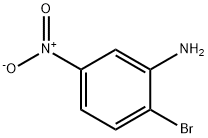
Uses
2-Bromo-5-nitroaniline reacts with phosgene iminium chloride to give a dimethylcarbamimidic chloride intermediate, which is then treated with primary amines to form guanidinyl derivatives and ultimately 5-nitrobenzimidazole derivatives[1]. 2-Bromo-5-nitroaniline can be acetylated and then thionated to give the corresponding thioamide, or heated with an amide and POCl3 in toluene to afford amidine derivatives[2].
References
[1]
Carpenter, A. J., Al-Barazanji, K. A., Barvian, K. K., Bishop, M. J., Britt, C. S., Cooper, J. P., Goetz, A. S., Grizzle, M. K., Hertzog, D. L., Ignar, D. M., Morgan, R. O., Peckham, G. E., Speake, J. D., Swain, W. R. (2006). Novel benzimidazole-based MCH R1 antagonists. Bioorganic & Medicinal Chemistry Letters, 16(19), 4994–5000.
https://doi.org/10.1016/j.bmcl.2006.07.054[2]
Brain, C. T., Brunton, S. A. (2002). An intramolecular palladium-catalysed aryl amination reaction to produce benzimidazoles. Tetrahedron Letters, 43(10), 1893–1895.
https://doi.org/10.1016/s0040-4039(02)00132-6