Synthesis

In a reaction flask, 1,4-dibromobutane (216 g, 1.0 mol) and 40% sodium hydride (90 g, 1.5 mol) were added, and the mixture was slowly heated to 50°C under nitrogen protection. Methyl acetoacetate (116 g, 1.0 mol) was slowly added, maintaining the temperature below 55°C. After the addition was complete, the mixture was heated and stirred at 50°C for 3 hours. The reaction was monitored by TLC until the reactants were fully reacted. Then, 1N... The pH of the reaction solution was adjusted to 8-9 with HCl solution, and the temperature was maintained at 60℃ for 2 hours. Then the temperature was lowered to 40℃. The organic phase was separated, washed once with 100 mL of saturated sodium chloride solution, dried with 5 g of anhydrous magnesium sulfate, and finally concentrated under vacuum to obtain 102 g of 1-CYCLOPENTYL-ETHANONE, with a yield of 91%.
Chemical Properties
Colorless Liquid
Uses
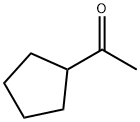
Cyclopentyl methyl ketone acts as a ligand for Suzuki coupling. Further, it reacts with benzo[1,2,5]oxadiazole 1-oxide to prepare 3-methylspiro(chinoxalin-2(3H),1'-cyclopentan)-3-amin-1,4-dioxide.
Synthesis
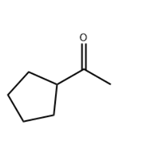
The preparation of 1-cyclopentylethanone: Condensation of 1,4-dibromobutane (XII) with tert-
butylacetoacetate (XIII) using NaOH in the presence of Bu4NBr,
or K2CO3 in the presence of Bu4NI in DMSO at 50 °C gives
tert-butyl 1-acetylcyclopentanecarboxylate (XIV), which
upon hydrolysis with HCl in i-prOH at 70 °C, TFA at 65 °C
or H2SO4 at 120 °C affords 1-cyclopentylethanone (XV) [1]. The reaction pathway is shown below:

References
[1] Tanturovska, B. S., Huwiler, A. (2020). Cenerimod. Sphingosine 1-phosphate receptor 1 (S1P1) agonist, Treatment of systemic lupus erythematosus.
Drugs of The Future,
1 1.
https://doi.org/10.1358/dof.2020.45.11.3176881