Chemical Properties
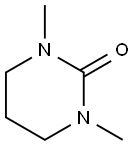
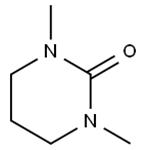
1,3-Dimethyl-3,4,5,6-tetrahydro-2(1H)-pyrimidinone is clear colorless to slightly yellowish liquid
Uses
1,3-Dimethyl-3,4,5,6-tetrahydro-2(1H)-pyrimidinone is a versatile organic solvent in and less toxic than HMPA. It is mainly applied in the synthesis of pharmaceuticals and agrochemicals. DMPU is also used in the electronics industry.
Uses
1,3-Dimethyl-3,4,5,6-tetrahydro-2(1H)-pyrimidinone is a versatile solvent used in the N-alkylation of chiral and O-alkylation of aldoses. It is involved in the preparation of poly(aryl ethers). It is a cyclic urea and used as a polar aprotic organic solvent. Further, it reacts with trifluoro-methanesulfonic acid anhydride to prepare 2,2'-oxy-bis(1,3-dimethyl-tetrahydropyrimidinium) bis(trifluoromethanesulfonate).
Uses
Versatile solvent employed in
N-alkylation of chiral, primary amines,
O-alkylation of aldoses, and in the synthesis of poly(aryl ethers).
Flammability and Explosibility
Non flammable
Synthesis
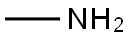
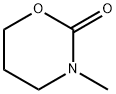
The general procedure for the synthesis of N,N-dimethylpropenyl urea and compounds (CAS:96690-06-1) from carbon dioxide, 1,3-dichloropropane and monomethylamine was as follows: 1.24 g of aqueous 1,3-dichloropropane and 5.15 g of a 40% aqueous solution of methylamine were added to a pressure vessel made of 20 mL of SUS316. At a pressure of about 0.5 MPa, 1.95 g of carbon dioxide gas was passed into the vessel. Subsequently, the reaction mixture was reacted at a constant temperature at 120°C for 2 hours. At the end of the reaction, 3-methyl-1,3-oxazin-2-one was obtained in 15% yield, as well as 1,3-dimethyltetrahydropyrimidin-2(1H)-one in 64% yield.
References
[1] Patent: US2005/154200, 2005, A1. Location in patent: Page/Page column 4