Description
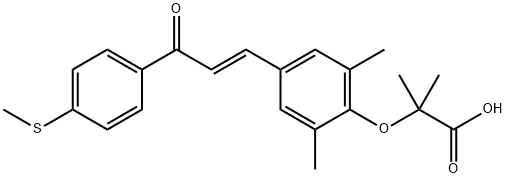
Elafibranor is an agonist of the peroxisome proliferator-activated receptors (PPAR) α and δ. It increases HDL secretion and expression of the lipid-related genes
ABCA1,
PLIN2, and
ABHD5 in Caco-2/TC7 cells in a PPARα-dependent manner. Elafibranor (10 mg/kg) decreases levels of plasma triglycerides and total cholesterol while increasing plasma HDL and expression of
Acox1, a PPARα target gene, in the liver of ApoE2-KI wild-type, but not PPARα knockout, mice fed a Western diet. However, PPARα knockout mice exhibit a decrease in plasma total and non-HDL cholesterol levels, indicating PPARδ has a role in these functions. Elafibranor (30 mg/kg) reduces diet-induced macro- and micro-steatosis in a PPARα-deficient mouse model of non-alcoholic steatohepatitis. It also reduces cholesterol and triglyceride accumulation as well as macrovesicular steatosis in the liver of insulin-resistant
db/db mice fed the methionine-choline deficient (MCD) diet. Formulations containing elafibranor are under clinical investigation for the treatment of non-alcoholic steatohepatitis.
Uses
GFT-505 is adualPPARα/δ agonist. Studies have shown that GFT-505 improves hepatic and peripheral insulin sensitivity in abdominally obese subjects. It may also be a potential new drug candidate for treating lipid and glucose disorders.
Biological Functions
Elafibranor (GFT505) is an agonist of peroxisome proliferator-activated receptor (PPAR) alpha and delta. EC50 values were 45 and 175 nM, respectively. GFT505 is being developed as a dual PPAR-α/PPAR-δ receptor agonist for the treatment of type 2 diabetes and nonalcoholic fatty liver disease. GFT1007 and GFT505 have an active metabolite, both with potent stimulant activity PPAR-α and to a lesser extent PPAR-δ.
Biological Activity
Elafibranor (GFT505) is an agonist of PPAR-alpha and PPAR-delta, improves insulin sensitivity, benefits glucose homeostasis, lipid metabolism and reduces inflammation.
in vivo
Elafibranor is well tolerated and does not cause weight gain or cardiac events, but does produce a mild, reversible increase in serum creatinine. Elafibranor improves glucose homeostasis, and lipid metabolism and reduces inflammation[2]. Elafibranor (GFT505) treatment improves glucose control and plasma lipids in diabetic db/db mice. A significant dose-dependent reduction of hepatic expression of the key gluconeogenic enzymes glucose 6-phosphatase (G6Pase), PEPCK, and fructose 1,6-bisphosphatase 1 (FBP1) is observed with Elafibranor. Elafibranor does not induce cardiac adverse effects of PPARγ-activating agonists in monkeys[3].
IC 50
PPAR-α: 45 nM (EC
50); PPAR-δ: 175 nM (EC
50)
References
[1] BERTRAND CARIOU. Effects of the new dual PPAR α/δ agonist GFT505 on lipid and glucose homeostasis in abdominally obese patients with combined dyslipidemia or impaired glucose metabolism.[J]. Diabetes Care, 2011, 34 9: 2008-2014. DOI:
10.2337/dc11-0093[2] BERTRAND CARIOU. Dual peroxisome proliferator-activated receptor α/δ agonist GFT505 improves hepatic and peripheral insulin sensitivity in abdominally obese subjects.[J]. Diabetes Care, 2013, 36 10: 2923-2930. DOI:
10.2337/dc12-2012[3] RÉMY HANF. The dual peroxisome proliferator-activated receptor alpha/delta agonist GFT505 exerts anti-diabetic effects in db/db mice without peroxisome proliferator-activated receptor gamma-associated adverse cardiac effects.[J]. Diabetes & Vascular Disease Research, 2014, 11 6: 440-447. DOI:
10.1177/1479164114548027[4] BART STAELS. Hepatoprotective effects of the dual peroxisome proliferator-activated receptor alpha/delta agonist, GFT505, in rodent models of nonalcoholic fatty liver disease/nonalcoholic steatohepatitis[J]. Hepatology, 2013, 58 6: 1941-1952. DOI:
10.1002/hep.26461[5] VLAD RATZIU . Elafibranor, an Agonist of the Peroxisome Proliferator−Activated Receptor−α and −δ, Induces Resolution of Nonalcoholic Steatohepatitis Without Fibrosis Worsening[J]. Gastroenterology, 2016, 150 5: Pages 1147-1159.e5. DOI:
10.1053/j.gastro.2016.01.038[6] JOOST BOECKMANS . Elafibranor restricts lipogenic and inflammatory responses in a human skin stem cell-derived model of NASH[J]. Pharmacological research, 2019, 144: Pages 377-389. DOI:
10.1016/j.phrs.2019.04.016