Uses
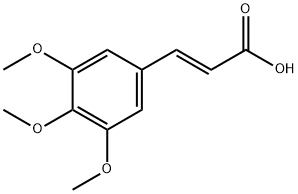
(E)-3,4,5-Trimethoxycinnamic acid (TMCA) is a cinnamic acid substituted by multi-methoxy groups. (E)-3,4,5-Trimethoxycinnamic acid is an orally active and potent GABAA/BZ receptor agonist. (E)-3,4,5-Trimethoxycinnamic exhibits favourable binding affinity to 5-HT2C and 5-HT1A receptor, with IC50 values of 2.5 and 7.6 μM, respectively. (E)-3,4,5-Trimethoxycinnamic acid shows anticonvulsant and sedative activity. (E)-3,4,5-Trimethoxycinnamic acid can be used for the research of insomnia, headache and epilepsy[1][2][3].
Definition
ChEBI: 3,4,5-trimethoxycinnamic acid is a methoxycinnamic acid with three methoxy substituents at the 3-, 4- and 5-positions. It has a role as an allergen. It is a conjugate acid of a 3,4,5-trimethoxycinnamate.
in vivo
(E)-3,4,5-Trimethoxycinnamic acid (0-20 mg/kg, IP, once) shows anti-seizure effects[2].
(E)-3,4,5-Trimethoxycinnamic acid (0-10 mg/kg, Orally, once) enhances hypnotic effects in pentobarbital-treated mice[3].
| Animal Model: | Ault male KunMing-strain mice (18-20 g, maximal electroshock (MES) and pentylenetetrazol (PTZ) models)[2] |
| Dosage: | 5, 10 and 20 mg/kg; 10 mL/kg |
| Administration: | IP, once |
| Result: | Significantly decreased the incidence of MES-induced THE (tonic hindlimb extension) to 50% and 20% of the value of the vehicle controls at 10 and 20 mg/kg. Decreased the incidence of MES-induced THE to only 80% at 5 mg/kg. Significantly delayed the onset of myoclonic jerks (MJ), and decreased the seizure severity and mortality compared with the vehicle-treated animals in PTZ seizure model. The incidence of generalized clonic convulsions (stage 4) disappeared at doses of both 10 and 20 mg/kg. |
| Animal Model: | ICR male mice (25-28 g, 10-12 in each group)[3] |
| Dosage: | 2, 5 and 10 mg/kg |
| Administration: | Orally (p.o.), once, 15 min and 1 h prior to pentobarbital injection |
| Result: | Significantly decreased locomotor activity at 10 mg/kg. Increased NREM and total sleep, but decreased wakefulness. |
IC 50
5-HT
1A Receptor: 7.6 μM (IC
50); 5-HT
2C Receptor: 2.5 μM (IC
50); 5-HT
2A Receptor: >10 μM (IC
50); 5-HT
6 Receptor: >10 μM (IC
50); 5-HT
7 Receptor: >10 μM (IC
50)
References
[1] Zhao Z, et al. Research progress in the biological activities of 3,4,5-trimethoxycinnamic acid (TMCA) derivatives. Eur J Med Chem. 2019 Jul 1;173:213-227. DOI:
10.1016/j.ejmech.2019.04.009[2] Chen CY, et al. 3,4,5-Trimethoxycinnamic acid, one of the constituents of Polygalae Radix exerts anti-seizure effects by modulating GABAAergic systems in mice. J Pharmacol Sci. 2016 May;131(1):1-5. DOI:
10.1016/j.jphs.2015.07.021[3] Lee CI, et al. 3,4,5-Trimethoxycinnamic acid (TMCA), one of the constituents of Polygalae Radix enhances pentobarbital-induced sleeping behaviors via GABAAergic systems in mice. Arch Pharm Res. 2013 Oct;36(10):1244-51. DOI:
10.1007/s12272-013-0167-6