Synthesis
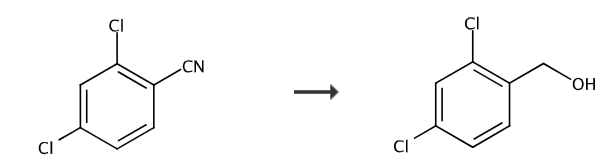
In a 100 mL round-bottom flask, 17.2 g of 2,4-dichlorobenzonitrile (0.1 mol) was added, followed by the dropwise addition of sulfuric acid (9.8 g, 0.1 mol). After the addition was complete, the mixture was kept at 125-130 °C for 2 hours. After the reaction was complete, the mixture was cooled to below 100 °C, diluted with water, and cooled to below 50 °C. The mixture separated into layers, and the starting material was removed. The resulting solution was dehydrated under reduced pressure and concentrated to half its original volume. After cooling, crystals were precipitated to obtain 17.38 g of 2,4-dichlorobenzoic acid, with a yield of 91%.
In a 100 mL round-bottom flask, 19.1 g (0.1 mol) of 2,4-dichlorobenzoic acid and 30 mL of ethanol were added. Then, a mixed solution of NaBH
sub>4 (1.9 g, 0.05 mol) and an alkenyl base (10 mL, 2% sodium hydroxide solution) was slowly added dropwise at 0 °C. After the addition was complete, the mixture was stirred for 1 h. The mixture was filtered, and the residue was washed three times with ethanol (5 mL × 3). The resulting organic phase was distilled to give 15.05 g of 2,4-dichlorobenzyl alcohol, with a yield of 85%.
Chemical Properties
white to light yellow crystal powde
Uses
An surgical antiseptic.
Uses
2,4-Dichlorobenzyl alcohol is an antiseptic found in commercially available throat lozenges. Also used deactivate Respiratory syncytial virus and SARS-Cov.
Definition
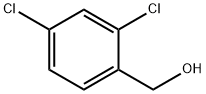
ChEBI: A member of the class of benzyl alcohols that is benzyl alcohol in which the hydrogens at positions 2 and 4 are replaced by chlorines. It has a role as an antiseptic drug. It is a member of benzyl alcohols and a dichlorobenzene.
General Description
2,4-Dichlorobenzyl alcohol is a constituent of commercially available lozenges for acute sore throat caused by upper respiratory tract infections.
Pharmaceutical Applications
Amylmetacresol and 2,4-dichlorobenzyl alcohol throat lozenges have been shown to be safe and efficient in relieving of acute sore throat symptoms, and it produces an immediate symptomatic relief.[3]
Mechanism of action
In-vitro evidence has demonstrated the virucidal effect of Amylmetacresol (AMC) and 2,4-dichlorobenzyl alcohol (DCBA) on a number of viruses associated with the common cold; a reduction in viral load is believed to have benefits in reducing the symptoms. The local anesthetic action of AMC/DCBA throat lozenges, a combination of the potent channel blocker – AMC and the reduced potency for sodium channel blockade DCBA – attenuate the effects of AMC, possibly as a result of competitive binding, which acts on a sodium channel blocker, and may be effective in relieving symptoms due to inflammation. Therefore, AMC/DCBA throat lozenge is thought to represent a useful option to meet patients' needs and avoid unnecessary prescription of antibiotics[1].
Clinical Use
Amylmetacresol and 2,4-dichlorobenzyl alcohol throat lozenges have been marketed in many countries worldwide for pain relief in acute sore throat. Amylmetacresol and 2,4-dichlorobenzyl alcohol throat lozenges have been shown to be safe and efficient in relieving of acute sore throat symptoms, and it produces an immediate symptomatic relief. Local symptomatic pain relief plays an important role in managing acute sore throat[1-2].
Side effects
COMMON SIDE EFFECTS: Difficulty in breathing, Tongue soreness, Hypersensitivity reactions, Swelling of the face, Tongue, Throat and Neck.
References
[1] Ting W Tan. "Effectiveness of amylmetacresol and 2,4-dichlorobenzyl alcohol throat lozenges in patients with acute sore throat due to upper respiratory tract infection: a systematic review protocol." JBI database of systematic reviews and implementation reports (2017): 862–872.
[2] Thomas, Michael J. "ACP Journal Club. Amylmetacresol and 2, 4-dichlorobenzyl alcohol lozenges were better than placebo lozenges for relief of acute sore throat." Annals of Internal Medicine 153 4 (2010): JC2-6.
[3] Tan, T. W., Chen, B. C., Tan, H. L., & Chang, C. M. (2017). Effectiveness of amylmetacresol and 2,4-dichlorobenzyl alcohol throat lozenges in patients with acute sore throat due to upper respiratory tract infection: a systematic review protocol. JBI Database of Systematic Reviews and Implementation Reports, 862–872.
https://doi.org/10.11124/JBISRIR-2016-003034