Chemical Properties
White to slightly beige crystalline powder
Uses
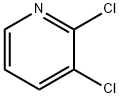
2,3-Dichloropyridine is used as a reagent for the preparation of substituted 3-(5-membered heterocycle-carboxamido)pyridine derivatives for treatment of autoimmune and inflammatory diseases. Also in the synthesis, crystal structure and biological activity of novel anthranilic Diamide insecticide with propargyl ether.
Application
As an important fine chemical intermediate, 2,3-Dichloropyridine has been usually applied to the field of pesticide and medicine research.
Reactions
2,3-Dichloropyridine reacts with strong oxidizing agents and mineral acids.
Hazard
2,3-Dichloropyridine is irritating to skin and eyes. It is also irritation to tissues of the mucous membranes and upper respiratory tract.
Synthesis
2,3-dichloropyridine is synthesized from 2-chloronicotinic acid via amidation, Hofmann degradation, diazotization and Sandmeyer reaction.
Structure and conformation
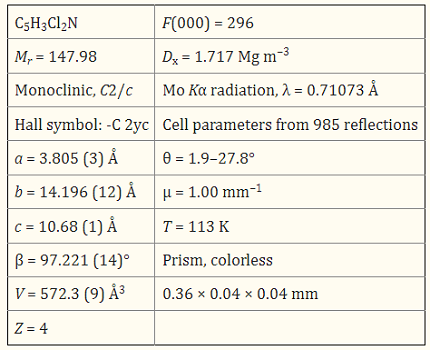
The complete mol-ecule of 2,3-Dichloropyridine, C5H3Cl2N, is generated by crystallographic twofold symmetry, which forces the pyridine N atom and the opposite C—H group to be statistically disordered. In the crystal, weak aromatic π–π stacking [centroid–centroid separation = 3.805 (4)Å and slippage = 1.704Å] leads to [100] stacks of mol-ecules. Short Cl···Cl contacts [3.334 (3)Å] are also observed. Colourless prisms were grown from ethanol.