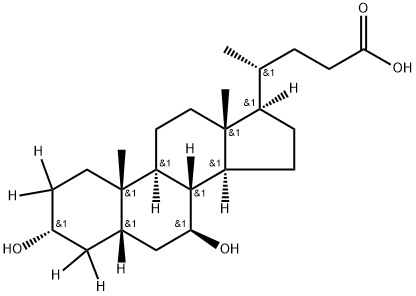
Description
Ursodeoxycholic acid-d
4 (UDCA-d
4) is intended for use as an internal standard for the quantification of UDCA (Item No.
15121) by GC- or LC-MS. UDCA is a secondary bile acid formed
via epimerization of chenodeoxycholic acid (CDCA; ). UDCA is also a metabolite of lithocholic acid (LCA; ) in human liver microsomes. It inhibits taurocholic acid uptake in HeLa cells expressing recombinant sodium/taurocholate cotransporting polypeptide (NTCP) with an IC
50 value of 3.6 μM. UDCA (50 μM) inhibits apoptosis induced by deoxycholic acid (DCA; Item Nos.
20756 |
18231) or ethanol in primary rat hepatocytes. Dietary administration of UDCA blocks DCA-induced increases in the number of TUNEL-positive hepatocytes in rats. Formulations containing UDCA have been used in the treatment of primary biliary cirrhosis.
Uses
Ursodeoxycholic Acid-d4 is a deuterated form of Ursodeoxcholic Acid (U850000), which is used as an anticholelithogenic. Ursodeoxcholic Acid is an epimer with Chenodiol with respect to the hydroxyl group at C7. Ursodeoxycholic Acid-d4 was used as an internal standard for rapid quantification of bile acids by liquid chromatography-tandem mass spectrometry.
References
[1] PAUL A DAWSON Saul J K. Intestinal transport and metabolism of bile acids.[J]. Journal of Lipid Research, 2015, 56 6: 1085-1099. DOI:
10.1194/jlr.r054114[2] ANAND K DEO S M B. 3-ketocholanoic acid is the major in vitro human hepatic microsomal metabolite of lithocholic acid.[J]. Drug Metabolism and Disposition, 2009, 37 9: 1938-1947. DOI:
10.1124/dmd.109.027763[3] R B KIM. Modulation by drugs of human hepatic sodium-dependent bile acid transporter (sodium taurocholate cotransporting polypeptide) activity.[J]. Journal of Pharmacology and Experimental Therapeutics, 1999, 291 3: 1204-1209.
[4] C M RODRIGUES. A novel role for ursodeoxycholic acid in inhibiting apoptosis by modulating mitochondrial membrane perturbation.[J]. Journal of Clinical Investigation, 1998, 101 12: 2790-2799. DOI:
10.1172/jci1325