Description
Hydroxy-PEG4-t-butyl ester is a PEG linker containing a hydroxyl group with a t-butyl ester. The hydrophilic PEG spacer increases solubility in aqueous media. The hydroxyl group enables further derivatization or replacement with other reactive functional groups. The t-butyl protected carboxyl group can be deprotected under acidic conditions.
Uses
This heterobifunctional, PEGylated crosslinker features a hydroxyl group at one end and t-butyl-protected carboxylic acid at the other, which can be deprotected with acidic conditions. The hydrophillic PEG linker facilitates solubility in biological applications. Hydroxy-PEG4-t-butyl ester can be used for bioconjugation or as a building block for synthesis of small molecules, conjugates of small molecules and/or biomolecules, or other tool compounds for chemical biology and medicinal chemistry that require ligation. Examples of applications include its synthetic incorporation into antibody-drug conjugates or proteolysis-targeting chimeras (PROTAC
molecules) for
targeted protein degradation.
reaction suitability
reagent type: cross-linking reagent
Synthesis
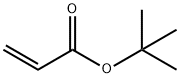
GENERAL STEPS: A piece of sodium (~1/4 cm) was added to an anhydrous tetrahydrofuran (THF, 125 mL) solution of tetraethylene glycol triacetonide (40.61 mL; 45.64 g; 235 mmol). After the sodium was fully reacted, tert-butyl acrylate (11.98 mL; 10.57 g; 82.5 mmol) was added dropwise over 20 min and the reaction mixture was stirred overnight at room temperature. Upon completion of the reaction, the pH was adjusted to 7-8 with 1N NaOH solution and the solvent was subsequently removed under reduced pressure. The residue was dissolved in a mixed solution of saturated NaHCO3 and NaCl (75 mL) and extracted with ethyl acetate (EtOAc, 3 x 100 mL). The organic layers were combined, dried with anhydrous magnesium sulfate (MgSO4), filtered, and the solvent evaporated under reduced pressure to afford tert-butyl-15-hydroxy-4,7,10,13-tetraoxapentadecanoate (21.87 g; 67.8 mmol; 82% yield, based on calculation of tert-butyl acrylate) as a colorless oil. The product was characterized by 1H-NMR (500 MHz, CDCl3, TMS) and 13C{1H}-NMR (126 MHz, CDCl3, TMS) with the following data: 1H-NMR δ [ppm] = 3.77-3.57 (m, 18H, OCH2); 3.01 (bs, 1H, OH); 2.51 (t, 2H, J = 6.6 Hz, CH2COO'Bu); 1.45 (s, 9H, C(CH3)3); 13C{1H}-NMR δ [ppm] = 171.1 (COO); 80.7 (C(CH3)3); 72.6 / 70.8 / 70.7 / 70.6 / 70.5 / 67.0 (OCH2); 61.9 (HOCH2); 36.4 ( CH2CO); 28.2 (C(CH3)3).
IC 50
Non-cleavable Linker; Alkyl/ether; PEGs
References
[1] Synthetic Communications, 2004, vol. 34, # 13, p. 2425 - 2432
[2] Patent: WO2016/146638, 2016, A1. Location in patent: Page/Page column 20
[3] Patent: WO2017/147542, 2017, A2. Location in patent: Paragraph 00162
[4] Patent: WO2018/89373, 2018, A2. Location in patent: Paragraph 0638-0639
[5] Tetrahedron, 2011, vol. 67, # 12, p. 2251 - 2259



![Bis[2-(2-hydroxyethoxy)ethyl] ether](/CAS/GIF/112-60-7.gif)