Uses
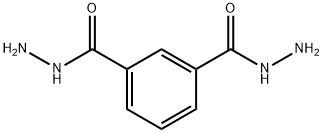
Isophthalic dihydrazide serves as a precursor for synthesizing Schiff bases through condensation with substituted benzaldehydes, including 2-hydroxy-3-methoxybenzaldehyde, to evaluate antioxidant properties[6].
Synthesis
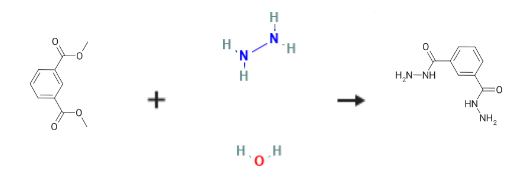
Isophthalic dihydrazide is prepared by the reaction of Dimethyl isophthalate and Hydrazine hydrate. The specific synthesis steps are as follows:
A mixture of dimethyl ester of isophthalic acid (2.22 gm) and hydrazine hydrate (98percent, 2 cc) in methanol was refluxed for 5 hours and the reaction mixture was allowed to cool to room temperature. Then, the cooled reaction mixture was poured on to ice cold water. The dihydrazide of isophthalic acid thus obtained was filtered and recrystallized from ethanol. [1] Yield: (85percent), M.P=241℃, (Scheme1). 1HNMR (400 MHz, CDCL3, ppm): 9.81 (s, 2H, -CO-NH-), 8.20 (s 1H ), 7.8(d, 2H, J=7.6 Hz), 7.5 (t, 1H, 7.2 Hz), 4.5 (s, 4H).
References
[1] Journal of the American Chemical Society, 2018,
[2] Bioorganic Chemistry, 2018, vol. 81, p. 389 - 395
[3] Pharmaceutical Chemistry Journal, 2001, vol. 35, # 12, p. 653 - 656
[4] Heterocyclic Communications, 2008, vol. 14, # 1-2, p. 101 - 105
[5] Organic and Biomolecular Chemistry, 2014, vol. 12, # 25, p. 4445 - 4453
[6]Khan, M., Raheel, M., Shah, S., Ibrahim, M., Asif, M., Salar, U., & Khan, K. M. (2023). Synthesis, Characterization, DPPH, Ferric Reducing, and Ferrous Ion- Chelating Activities of Isophthalate Schiff Bases. Letters in Drug Design & Discovery, 20(1), 31–39.
https://doi.org/10.2174/1570180819666220429151008