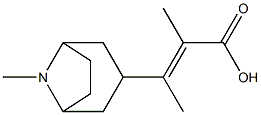
Description
A tropine alkaloid isolated from Duboisia rnyoporoides, this base is a colourless
syrup which yields crystalline salts. The hydrobromide forms colourless, tabular
crystals m.p. 234-5°C and is optically inactive; the aurichloride crystallizes as
yellow plates, m.p. 213.5- 2140 C; the picrate as yellow rectangular plates, m.p.
239°C and the methiodide as square plates, m.p. 244-5°C. The alkaloid is
unsaturated and the hydro bromide, on hydrogenation, furnishes dihydrotigloidine,
giving a picrate, m.p. l34-5°C. When treated with bromine in CHC13 it forms
dibromodihydrotigloidine, m.p. 187°C (dec.). The free base may be hydrolyzed
by boiling with H20 when it furnishes pseudotropine and tiglic acid. The base is
therefore the tiglyl ester of pseudotropine. By comparison, tiglyltropine gives a
hydrobromide with m.p. 207°C and a picrate, m.p. 200°C.
in vivo
Tigloidine hydrobromide (20-60 mg/kg, i.p.) fails to protect the mice against the lethal effect of physostigmine, but at 100 mg/kg and above, it protects 80% of the animals against the lethal effect. Tigloidine markedly prevents tremor and salivation produced by tremorine at 80-100 mg/kg, but fails to prevent these effects in doses up to 40 mg/kg. Tigloidine (up to 100 mg/kg, i.p) does not significantly affects reserpine and tetrabenazine induced sedation and ptosis in mice. Tigloidine (25-50 mg/kg, i.p.) also fails to cause any behavioral changes in the cats[1].
References
Barger, Martin, Mitchel1.,J. Chern. Soc., 1820 (1937)