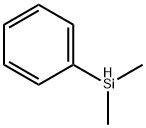
Synthesis
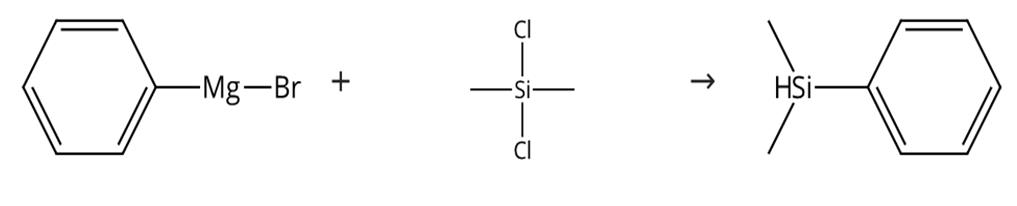
A solution of dichlorodimethylsilane (5 g, 38.5 mmol) in dry ether (20 mL) was added dropwise at 0 °C under argon atmosphere to a stirred solution of magnesium phenyl bromide (prepared from bromobenzene) (6.55 g, 42 mmol) and magnesium (1.0 g, 42 mol) in dry diethyl ether (30 mL). The solution was then refluxed for 24 hours and cooled to room temperature. Pentane (40 mL) was added and the solution was filtered. The solvent was evaporated under vacuum at a temperature below 40 °C, and the product was distilled under reduced pressure to give Dimethylphenylsilane.
Chemical Properties
Clear colorless liquid
Physical properties
bp 157 °C/744 mmHg; d 0.889 g cm3.
Uses
Diastereoselective Reduction of Carbonyl Compounds.
Hydrosilylation. With a transition metal catalyst, the
hydrosilane adds to carbon–carbon double or triple bonds to
give alkylsilanes or alkenylsilanes.
Hydrosilylating reagent; reductant in combination with acid
or F).
Uses
Dimethylphenylsilane is a reagent for enol ether synthesis. It acts as a catalyst. Also used as a precursor in Optical Emission Spectroscopy of Plasma Deposition Processes. It can react with vinylbenzene to produce (b-Phenyl-ethyl)-dimethylphenyl-silan.
Application
Used to reduce α-amino ketones to aminoethanols withhigh stereoselectivity. Used in the fluoride ion-catalyzedreduction of aldehydes and ketones, and α-substitutedalkanones to threo products. Erythro reduction of α-substituted alkanones to diols and aminoethanols. Together with CuCl reduces aryl ketones, but not dialkylketones. Used in the silylformylation of acetylenes.Excellent reducing agent for the reduction of enones tosaturated ketones. Shows better selectivity than LAH inthe reduction of oximes to alkoxyamines.