Description
Arsenic is a metalloid of the nitrogen group. Two allotrope forms of elemental arsenic have been reported:
yellow arsenic and grey arsenic, the latter being usually the more stable form. Arsenic readily oxidises in
air to arsenic trioxide (As
2O
3). Arsenic is mostly found either in its native state or as arsenic sulfide in the
form of realgar (As
4S
4) or orpiment (As
2S
3). Arsenic can exist in three different valence states (zerovalent,
trivalent and pentavalent). Arsenic forms covalent bonds with carbon, oxygen and hydrogen. The toxicity
varies widely and depends on the physical state of the compound and its absorption/elimination rate.
Trivalent arsenics (As(III)) are derivatives of the arsenous acid (H
2AsO
3-arsenite) and arsenic trioxide
(AsO
3). Examples of pentavalent arsenic (As(V)) include derivatives of the arsenic acid (H
3AsO
4 -arsenate).
Organic arsenic-based compounds, that is, compounds containing arsenic-carbon bonds, are usually less
toxic than their inorganic counterparts. This is mainly due to their quicker excretion from the human body.
Arsenic is known to be one of the most toxic heavy metals. Compounds containing arsenic have a long
history of use as poisons, but they also have a long historical medicinal use.
Chemical Properties
Arsenic (As) is the third element in Group VA of the periodic table. Elemental arsenic can be found in two solid forms: yellow and gray or metallic, with specific gravities of 1.97 and 5.73, respectively (CRC, 1999). Gray arsenic is the ordinary stable form. Arsenic compounds can be categorized as inorganic and organic. Inorganic compounds do not contain an arsenic–carbon bond while organic compounds do.
Chemical Properties
Elemental arsenic, as, occurs to a limited
extent in nature as a steel-gray, amorphous metalloid.
Physical properties
Arsenic is classed as a semimetal, meaning that it is neither a metal like aluminum or lead,nor quite a nonmetal such as oxygen, sulfur, or chlorine. Arsenic’s main allotrope is a silverygray,brittle, metal-like substance. Its other two isotopes are unstable crystalline substances.
Gray arsenic exhibits an unusual property in that its boiling point (614°C) is lower than itsmelting point (817°C). As its temperature changes, it sublimates, which means it goes fromthe solid state, skipping the liquid state, into a vapor state. Cooling the vapor of sublimation,the black allotrope condenses out and in turn changes from the black to the gray allotrope. Ifyellow arsenic is rapidly cooled from its sublimation point, yellow arsenic will condense outand will not revert back to gray arsenic upon cooling.
The following information is for the gray semimetal form of arsenic only. Its melting pointis 817°C, its sublimation point varies between 613°C and 814°C depending on the atmosphericpressure, and its density is 5.776 g/cm
3.
Isotopes
There are a total of 35 isotopes of arsenic, ranging from As-60 to As-92, withhalf-lives spanning from a few nanoseconds to 80 days. Although some references claimthere are no stable isotopes of arsenic, arsenic-75 is classed as a stable isotope thatmakes up 100% of arsenic found in the Earth’s crust.
Origin of Name
Derived either from the Latin word arsenicum or the Greek word arsenikon,
both meaning a yellow pigment. It is possible that the Arabic word azzernikh was
also an ancient name for arsenic.
Occurrence
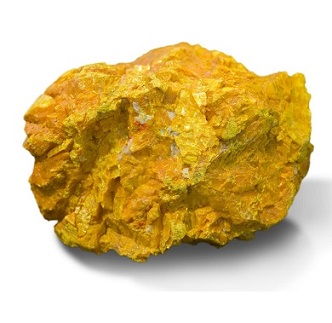
Arsenic is the 53rd most abundant element and is widely distributed in the Earth’s crust.It occurs naturally in several minerals, but high-grade deposits are rare. Most of the mineralsand ores that contain arsenic also contain other metals. Some major sources of arsenic are theminerals orpiment, scherbenkobalt, arsenopyrite, niccolite, realgar, gersdorffite, and smaltite.In addition, most sulfide ores of other metals also contain some arsenic. The three major mineralsthat produce arsenic are: realgar (arsenic monosulfide, AsS), orpiment (arsenic trisulfide,As
2S
2), and arsenopyrite (iron arsenosulfide, FeAsS).
Today, most arsenic is recovered as a by-product from the smelting of nickel, copper, iron,and tin. It is also recovered from the flue dust of copper- and lead-smelting furnaces.
Characteristics
Arsenic in the elemental form is a brittle, grayish crystal that becomes darker when exposedto air. It is seldom found in the pure elemental form but rather in minerals (compounds). Ithas a long history of use as a poison, and many alchemists were poisoned when using it intheir attempts to produce gold from base metals.
Arsenic has limited commercial use.
History
Mineral forms of arsenic were known as early as the fourth century BC, but the German saint Albertus Magnus, also known as Albert the Great, confirmed the existence of arsenic in 1250 AD. His discovery process involved soap and orpiment, a volcanic mineral that contains arsenic sulfide. Albertus heated the two compounds together and isolated arsenic. His experiment yielded arsenic with a few impurities.
Almost 300 years later, Paracelsus would publish the first known treatise instructing on the preparation of arsenic. It is only one of his achievements that would make him the father of toxicology.
Arsenic has been called the "King of Poisons". From the time of the Roman Empire, which was established at around 600 BC through the Middle Ages (5th – 15th C) to the Renaissance (15th and 16th C), it was a popular way to get rid of unwanted relatives or rivals. Sometimes the motives were political, sometimes personal. The use of arsenic to knock off inconvenient people was finally slowed down by advances in chemistry and forensic science. Once a test was developed to measure arsenic in tissue or body fluids in 1836, it was possible to prove the cause of death, making it much harder to get away with the crime.
Uses
Arsenic is a brittle solid with a metallic coloring that ranges from silver to gray. It is a naturally occurring element found in the earth’s crust, and it cycles rapidly through water, land, air, and living systems. Exposure to it occurs through ingestion, inhalation, and dermal contact.
The arsenic metalloid is used for hardening copper and lead alloys (HSDB, 2005). It is also used in glass manufacturing as a decolorizing and refining agent, as a component of electrical devices in the semiconductor industry, and as a catalyst in the production of ethylene oxide. Arsenic compounds are used as a mordant in the textile industry, for preserving hides, as medicinals, pesticides, pigments, and wood preservatives. The production of chromate copper arsenate (CCA), a wood preservative, accounts for approximately 90% of the domestic arsenic consumption (ATSDR, 2007). However, production of this preservative is being phased out. The uses of inorganic arsenical compounds (e.g., lead arsenate) as pesticides were voluntarily cancelled by the industry during late 1980s and early 1990s. A majority of organoarsenicals are used on cotton and turf as herbicides. disodium methanearsenate (DSMA), monosodium methanearsenate (MSMA), and calcium methanearsenate (CAMA) continue to be used as contact herbicides.
Uses
Arsenic is used for hardening metals suchas copper and lead and as a doping agentin solid-state products of silicon and germanium.Its salts are used in making herbicidesand rodenticides, in semiconductors, and inpyrotechnics. Arsenic trioxide is being usedin experimental research for treating solidtumors such as gastric cancer and head andneck tumors.
Uses
Inorganic arsenic compounds were widely used as pesticides from the mid 1800s to the mid 1900s and were used in medicine until the 1970s, primarily for treatment of leukemia, psoriasis, and asthma. The use of arsenic for treatment of acute promyelocytic leukemia resumed in the 1990s. By the mid 1970s, arsenic use was shifting from pesticides to wood preservatives, and by 1980, wood preservatives were the primary use. Total agricultural-chemical use (in pesticides and fertilizers) declined to about 15% to 20% of total arsenic consumption by the early 1990s and has remained at about 4% since 1995 (Edelstein 1994, Reese 1998, ATSDR 2007, Brooks 2009).
Since the mid 1990s, arsenic trioxide used in wood preservation has accounted for 86% to 90% of total U.S. arsenic consumption. Wood treated with chromated copper arsenate (CCA), known as “pressure-treated wood,” has been used widely to protect utility poles, building lumber, and foundations from decay and insect attack. However, a voluntary phase-out of CCA for certain residential uses (e.g., in wood for decks, play structures, fencing, and boardwalks) that went into effect December 31, 2003, has reduced this use of arsenic. CCA continues to be used in wood products for industrial use. Other uses of arsenic in the 1990s included use in glass (3% to 4%) and nonferrous alloys (1% to 4%) (ATSDR 2007, Brooks 2009).
By the 1990s, there was renewed interest in the use of arsenic for treatment of acute promyelocytic leukemia (ATSDR 2007). Arsenic trioxide is approved by the U.S. Food and Drug Administration for treating this type of leukemia when other chemotherapy treatments have failed (MedlinePlus 2009). Arsenic is also used in the production of lead alloys used in lead-acid batteries. It may be added to alloys used for bearings, type metals, lead ammunition, and automotive body solder, and it may be added to brass to improve corrosion resistance. High-purity arsenic is used in a variety of semiconductor applications, including solar cells, light-emitting diodes, lasers, and integrated circuits (ATSDR 2007).
Uses
Over the years a number of practical uses for arsenic developed, particularly related toits poisonous nature. Today, it is not of great commercial value except as an insecticide andherbicide.
It is used in the semiconductor industry to coat solid-state devices. Some compounds areused in paints and fireworks. The major uses are in medicine, where its toxic properties areimportant for the treatment of diseases.
Definition
arsenic: Symbol As. A metalloid elementof group 15 (formerly VB) ofthe periodic table; a.n. 33; r.a.m.74.92; r.d. 5.7; sublimes at 613°C. Ithas three allotropes-yellow, black,and grey. The grey metallic form isthe stable and most common one.Over 150 minerals contain arsenicbut the main sources are as impuritiesin sulphide ores and in the mineralsorpiment (As
2S
3) and realgar(As
4S
4). Ores are roasted in air toform arsenic oxide and then reducedby hydrogen or carbon to metallic arsenic.Arsenic compounds are used ininsecticides and as doping agents insemiconductors. The element is includedin some lead-based alloys topromote hardening. Confusion canarise because As
4O
6 is often sold aswhite arsenic. Arsenic compoundsare accumulative poisons. The elementwill react with halogens, concentratedoxidizing acids, and hot alkalis.Albertus Magnus is believed tohave been the first to isolate the elementin 1250.
Definition
A toxic metalloid element existing in
several allotropic forms; the most stable is
a brittle gray metal. It belongs to group 15
(formerly VA) of the periodic table. Arsenic
is found native and in several ores including
mispickel (FeSAs), realgar (As
4S
3),
and orpiment (As
2S
3). The element reacts
with hot acids and molten sodium hydroxide
but is unaffected by water and acids
and alkalis at normal temperatures. It is
used in semiconductor devices, alloys, and
gun shot. Various compounds are used in
medicines and agricultural insecticides and
poisons.
Symbol: As; m.p. 817°C (gray) at 3
MPa pressure; sublimes at 616°C (gray);
r.d. 5.78 (gray at 20°C); p.n. 33; r.a.m.
74.92159.
Production Methods
The process most often reported in the litera ture treats white arsenic with hydrochloric acid to form arsenic trichloride: As2O3 +6HCl → 2AsCl3+3H2O
The arsenic trichloride is purified by fractional distillation, possibly in combination with chem ical methods. It subsequently is reduced by re action with hydrogen at 800–850℃, and the metal vapor is condensed in crystalline form at 400–450℃.
4AsCl3 +6H2 → As4+6HCl
After sublimation,the metal is packaged in glass ampoules. An arsenic content of >99.99 % can be obtained by this method.
General Description
A grayish metallic solid that turns black upon exposure to air. Insoluble in water. Toxic by ingestion.
Air & Water Reactions
Turns black on exposure to air. Insoluble in water.
Reactivity Profile
Arsenic reacts incandescently with bromine trifluoride, even at 10°C [Mellor 2:113 1946-47]. Causes bromoazide to explode upon contact. Ignites if ground up together with solid potassium permanganate [Mellor 12:322 1946-47]. Is oxidized by sodium peroxide with incandescence [Mellor 2:490-93 1946-47]. A combination of finely divided Arsenic with finely divided bromates (also chlorates and iodates) of barium, calcium, magnesium, potassium, sodium, or zinc can explode by heat, percussion, and friction [Mellor 2:310 1946-47]. Bromine pentafluoride reacts readily in the cold with Arsenic. Ignition usually occurs. Reacts vigorously with fluorine at ordinary temperatures [Mellor 9:34 1946-47].
Hazard
Most of the compounds of arsenic are toxic when in contact with the skin, when inhaled,or when ingested. As with arsenic’s cousin phosphorus above it in group 15 of the periodictable, care must be taken when using arsenic. The compound arsenic trioxide (As
2O
3), anexcellent weed-killer, is also carcinogenic. Copper acetoarsenite, known as Paris green, is usedto spray cotton for boll weevils. A poisonous dose of arsenic as small as 60 milligrams can bedetected within the body by using the Marsh test.
Health Hazard
One of the allotropic forms, yellow arsenic,is a severe human poison. The fatal dosein humans is 1–2 mg/kg body weight. Allarsenic compounds are toxic, the toxicityvarying with the oxidation state of themetal and the solubility. Thus, the trivalentinorganic compounds of arsenic, suchas arsenic trichloride, arsenic trioxide, andarsine, are highly toxic—more poisonousthan the metal and its pentavalent salts.The organic arsenic compound Lewisite isa severe blistering agent that can penetratethe skin and cause damage at the point ofexposure. Lewisite was used as a poison gasin World War I. Less soluble arsenic sulfideexhibits a lower acute toxicity.
Arsenic is absorbed into the body througha GI route and inhalation. The acute symptomsinclude fever, GI disturbances, irritationof the respiratory tract, ulceration of thenasal septum, and dermatitis. Chronic exposurecan produce pigmentation of the skin,peripheral neuropathy, and degeneration ofliver and kidneys.
The toxic effects of arsenic are attributedto its binding properties with sulfur. It formscomplexes with coenzymes. This inhibitsthe production of adenosine triphosphate (ATP), which is essential for energy in bodymetabolism. 2,3-Dimercapto-1-propanol isan antidote against acute intoxication. 2,3-Dithioerythritol is reported to be a moreeffective and less toxic antidote (Boyd et al.1989). Arsenic is carcinogenic to humans.Ingestion by an oral route has caused anincreased incidence of tumors in the liver,blood, and lungs. The mutagenic and genotoxiceffects of arsenic have been reviewed(Basu et al. 2001).
Peraza et al. (2003) studied toxicity andmetabolism of inorganic arsenic in kidneyat low level subcytotoxic concentrations.Human renal proximal tubule epithelial cells(HK-2) were used as model in their study.The authors found that HK-2 cells werecapable of biotransforming inorganic arseniccompounds in a pathway involving reductionof arsenate to arsenite.
Bernstam et al. (2002) measured percutaneousabsorption of As(III) and As(V) invitro using artificial human skin. The permeabilityconstant (Kp) for As(V) and As(III)were determined from this study as 4.3× 10
-5 cm/h and 10.1× 10
-5 cm/h respectively.As(III) at exposure doses as low as10 μg/L could cause significant morphologicalchanges, disruption of cell membrane andinhibition of deoxyribonucleic acid (DNA)and protein syntheses. The authors noted thatconcentrations of tri- or pentavalent arsenicat levels above 100 μg/L in showering- orhand-washing waters could manifest harmfuleffects.
Flammability and Explosibility
Not classified
Industrial uses
Arsenic (symbol As) is a soft, brittle, poisonouselement of steel-gray color and metallic luster.In atomic structure it is a semimetal, lackingplasticity, and is used only in alloys and incompounds. The bulk of the arsenic used isemployed in insecticides, rat poisons, and weedkillers, but it has many industrial uses, especiallyin pigments. It is also used in poisongases for chemical warfare.Metallic arsenic is stable in dry air. Whenexposed to humid or moistened air, the surfacefirst becomes coated with a superficial goldenbronze tarnish, which on further exposure turnsblack. On heating in air arsenic will vaporizeand burn to As2O3.
Safety Profile
Confirmed human
carcinogen producing liver tumors. Poison
by subcutaneous, intramuscular, and
intraperitoneal routes. Human systemic skin
and gastrointestinal effects by ingestion. An
experimental teratogen. Other experimental
reproductive effects. Mutation data
reported. Flammable in the form of dust
when exposed to heat or flame or by
chemical reaction with powerful oxidizers
such as bromates, chlorates, iodates,
peroxides, lithium, NC4, m 0 3 , Khfn04,
Rb2C2, AgN04, NOCl, IF5, CrO3, CIF3,
Cl0, BrF3, BrFj, BrN3, RbGBCH,
CsC3BCH. Slightly explosive in the form of
dust when exposed to flame. When heated
or on contact with acid or acid fumes, it
emits highly toxic fumes; can react
vigorously on contact with oxidizing
materials. Incompatible with bromine azide,
dirubidium acetylide, halogens, palladium,
zinc, platinum, NCh, AgNO3, CrO3, Na2O2,
hexafluoroisopropylideneamino lithum.
Potential Exposure
Arsenic compounds have a variety of
uses. Arsenic and its compounds are used as an alloy additive,
in electronic devices; in veterinary medicines; in agriculture
as insecticides, herbicides, larvicides, and
pesticides. Some arsenic compounds are used in pigment
production; the manufacture of glass as a bronzing or
decolorizing agent; the manufacture of opal glass and
enamels, textile printing; tanning, taxidermy, antifouling
paints; to control sludge formation in lubricating oils.
Metallic arsenic is used as an alloying agent for heavy
metals; and in solders, medicines, herbicides. EPA has estimated
that more than 6 million people living within 12 mi
of major sources of copper, zinc, and lead smelters-may be
exposed to 10 times the average United States atmospheric
levels of arsenic. The agency says that 40,000 people living
near some copper smelters may be exposed to 100 times
the national atmospheric average.
First aid
If this chemical gets into the eyes, remove anycontact lenses at once and irrigate immediately for at least15 min, occasionally lifting upper and lower lids. Seek medical attention immediately. If this chemical contacts theskin, remove contaminated clothing and wash immediatelywith soap and water. Seek medical attention immediately. Ifthis chemical has been inhaled, remove from exposure,begin rescue breathing (using universal precautions, including resuscitation mask) if breathing has stopped and CPR ifheart action has stopped. Transfer promptly to a medicalfacility. When this chemical has been swallowed, get medical attention. Give large quantities of water and inducevomiting. Do not make an unconscious person vomit.Note to physician: For severe poisoning BAL [British AntiLewisite, Dimercaprol, dithiopropanol (C3H8OS2)] has beenused to treat toxic symptoms of certain heavy metals poisoning—including arsenic. Although BAL is reported to have alarge margin of safety, caution must be exercised, becausetoxic effects may be caused by excessive dosage. Most canbe prevented by premedication with 1-ephedrine sulfate(CAS: 134-72-5). Oral penicillamine (not penicillin) hasbeen used as a follow-up treatment or used instead of BALfor milder poisoning, with mixed success. Side effects mayoccur with such treatment and it is never a substitute forcontrolling exposure. Treatment can only be done understrict medical care.
Carcinogenicity
Arsenic and inorganic arsenic compounds are known to be human carcinogens based on sufficient evidence of carcinogenicity in humans.
Environmental Fate
Trivalent arsenic exerts its toxic effects mainly by disrupting
ATP production by inhibiting lipoic acid, which is a cofactor for
pyruvate as well by replacing phosphate which uncouples
oxidation phosphorylation. This inhibits the electron transport
chain in the mitochondria and the ultimate synthesis of ATP.
Hydrogen peroxide production is also increased, which, it is
speculated, has potential to form reactive oxygen species and
oxidative stress. These metabolic interferences lead to death
from multisystem cell death and organ failure. The activity of
enzymes is due to the functional groups on amino acids such as
the sulfhydryl group on cysteine or coenzymes such as lipoic
acid, which has vicinal thiol groups. Trivalent inorganic
arsenicals readily react with sulfhydryl groups such as cysteine
creating a strong complex between arsenic and vicinal sulfhydryl
reagents. These actions inhibit not only the formation of
Acetyl-CoA but also the enzymes succinic dehydrogenase and
pyruvate. Arsenite inhibits the binding of steroids to the
glucocorticoid receptor, but not other steroid receptors. The
probable mechanism of toxicity of pentavalent inorganic
arsenate is its reduction to a trivalent form, arsenite, which is
more toxic than the arsenate. Thus, a variety of mechanisms
lead arsenic to impair cell respiration and subsequently
diminish ATP formation.
storage
Color Code—Blue: Health Hazard/Poison: Store ina secure poison location. Prior to working with this chemicalyou should be trained on its proper handling and storage.Arsenic must be stored in a cool, dry place away from oxidizers (such as perchlorates, peroxides, permanganates, chlorates, and nitrates) and strong acids (such as hydrochloric,sulfuric, and nitric) since violent reactions occur. A regulated, marked area should be established where this chemicalis handled, used, or stored in compliance with OSHAStandard 1910.1045.
Shipping
UN1558 Arsenic, Hazard Class: 6.1; Labels:
6.1-Poisonous materials.
Toxicity evaluation
Bioconcentration of arsenic occurs in algae and lower
invertebrates. Both bottom-feeding and predatory fish can
accumulate contaminants found in water. The major bioaccumulation
transfer is between water and algae, at the base of
the food chain that has a strong impact on the concentration in
fish. Bottom-feeders are readily exposed to the greater quantities
of arsenic, which accumulate in sediments. No differences
were found for arsenic existing between bottom-feeders and
predators in tissue levels of metals and other contaminants.
Therefore, biomagnification in aquatic food chains does not
appear to be significant.
Incompatibilities
Incompatible with strong acids; strong
oxidizers; peroxides, bromine azide, bromine pentafluoride,
bromine trifluoride; cesium acetylene carbide, chromium
trioxide; nitrogen trichloride, silver nitrate. Can react vigorously
with strong oxidizers (chlorine, dichromate, permanganate).
Forms highly toxic fumes on contact with acids or
active metals (iron, aluminum, zinc). Hydrogen gas can
react with inorganic arsenic to form highly toxic arsine gas.
Toxics Screening Level
The initial risk screening level (IRSL) for arsenic and inorganic arsenic compounds is 0.0002 μg/m3 (annual averaging time).
Waste Disposal
Elemental arsenic wastes
should be placed in long-term storage or returned to
suppliers or manufacturers for reprocessing. Arsenic
pentaselenide-wastes should be placed in long-term storage
or returned to suppliers or manufacturers for reprocessing.
Arsenic trichloride: hydrolyze to arsenic trioxide utilizing
scrubbers for hydrogen chloride abatement. The trioxide
may then be placed in long-term storage. Arsenic trioxide:
long-term storage in large shiftproof and weatherproof
silos. This compound may also be dissolved, precipitated as
the sulfide and returned to the suppliers. Arsenic-containing
sewage may be decontaminated by pyrolusite treatment.
Consult with environmental regulatory agencies for guidance
on acceptable disposal practices. Generators of waste
containing this contaminant (≥100 kg/mo) must conform
with EPA regulations governing storage, transportation,
treatment, and waste disposal. In accordance with
40CFR165, follow recommendations for the disposal of
pesticides and pesticide containers. Must be disposed properly
by following package label directions or by contacting
your local or federal environmental control agency, or by
contacting your regional EPA office.