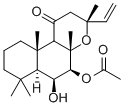
Description
Forskolin is a naturally-occurring diterpene that activates adenylyl cyclase through its catalytic subunit and is commonly used to raise levels of cAMP in a wide variety of intact cells and tissue preparations. 1,9-dideoxy Forskolin is an analog of forskolin that interacts with, but does not activate, adenylyl cyclase.
Uses
1,9-Dideoxyforkskolin does not activate adenylyl cyclase and is an inactive analog of Forskolin (F701800), a diterpene isolated from Coleus forskohlii, possessing vasodilating and cardiostimulatory properties. Forskolin resensitizes cell receptors by activating the enzyme adenylyl cyclase and increasing the intracellular levels of cAMP.
Definition
ChEBI: A labdane diterpenoid that is the 1,9-dideoxy derivative of forskolin.
References
[1] E M MCHUGH R M. Direct anesthetic-like effects of forskolin on the nicotinic acetylcholine receptors of PC12 cells.[J]. The Journal of Biological Chemistry, 1986, 261 7: 3103-3106.
[2] CIBELE PINTO . Differential interactions of the catalytic subunits of adenylyl cyclase with forskolin analogs[J]. Biochemical pharmacology, 2009, 78 1: Pages 62-69. DOI:
10.1016/j.bcp.2009.03.023