Uses
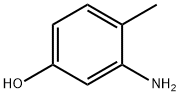
3-Amino-4-methylphenol serves as a precursor in oxidation reactions with a range of phenylenediamines, providing a general route to 1-aminophenoxazineimines; with p-phenylenediamine in dilute equimolar solution under bubbled oxygen, the hydroxyindamine forms quantitatively[6].
Synthesis
The general procedure for the synthesis of 3-amino-4-methylphenol from 4-methyl-3-nitrophenol was as follows: 4-methyl-3-nitrophenol (77 mg, 0.50 mmol), Fe nanoparticles (6 mg), and NaBH4 (29 mg, 0.75 mmol) were placed in 1.0 mL of 2 wt. % TPGS/H2O solution, and the reaction was carried out for 2 h at room temperature. Upon completion of the reaction, 56 mg (91% yield) of 3-amino-4-methylphenol was obtained as a white solid (hexane/ethyl acetate = 50:50). The melting point of the product was 154°C-156°C. It was analyzed by GC-MS with m/z of 123 [M], and the spectral data were consistent with those reported in the literature.
References
[1] Bioorganic and Medicinal Chemistry Letters, 2011, vol. 21, # 1, p. 240 - 244
[2] Green Chemistry, 2017, vol. 19, # 3, p. 809 - 815
[3] Journal of Medicinal Chemistry, 2010, vol. 53, # 5, p. 1964 - 1978
[4] ACS Catalysis, 2017, vol. 7, # 4, p. 2412 - 2418
[5] Patent: WO2018/208132, 2018, A1. Location in patent: Paragraph 704-708
[6]
Corbett, J. F. (1972). Benzoquinone imines. Part IX. Mechanism and kinetics of the reaction of p-benzoquinone di-imines with m-aminophenols. Journal of the Chemical Society, Perkin Transactions 2, 539.
https://doi.org/10.1039/p29720000539