Chemical Properties
Solid
Uses
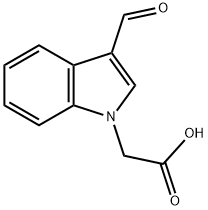
Handle to synthesize an indolecarboxaldehyde resin by coupling to an amino-resin. Amines and derivatives can be immobilized by reductive amination of this aldehyde resin. Mild cleavage with 50% TFA
reaction suitability
reagent type: cross-linking reagent
Synthesis
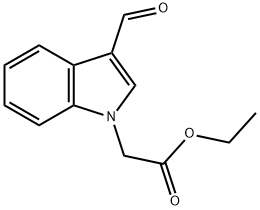
Ethyl (3-formyl-1H-indol-1-yl)acetate (15.9 g, 69 mmol) was dissolved in 1,4-dioxane (100 mL), 1 N sodium hydroxide solution (10 mL) was added, and the resulting mixture was stirred at 0 °C. The reaction mixture was then stirred at room temperature for 4 days. After completion of the reaction, water (500 mL) was added and the mixture was washed with ether (150 mL). The aqueous phase was acidified with 5 N hydrochloric acid to pH < 2 and subsequently extracted with ethyl acetate (250 mL + 150 mL) in two fractions. The organic phases were combined, dried over anhydrous magnesium sulfate, and concentrated under reduced pressure to give (3-formylindol-1-yl)acetic acid (10.3 g, 73% yield) as a white solid. The product was characterized by 1H-NMR (DMSO-d6): δH=5.20 (2H, s), 7.3 (2H, m), 7.55 (1H, d), 8.12 (1H, d), 8.30 (1H, s), 9.95 (1H, s), 13.3 (1H, br s).
References
[1] Patent: WO2006/82245, 2006, A1. Location in patent: Page/Page column 230
[2] Patent: US2005/65066, 2005, A1. Location in patent: Page/Page column 120
[3] Patent: WO2004/80480, 2004, A1. Location in patent: Page/Page column 226
[4] Patent: WO2006/5683, 2006, A1. Location in patent: Page/Page column 225
[5] Patent: US2003/229120, 2003, A1. Location in patent: Page 75