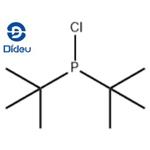
Chemical Properties
Colorless to light yellow liqui
Uses
Bulky ligand used with Pd(OAc)
2 in efficient Suzuki-Miyaura cross-couplings of arylboronic acids with aryl bromides and chlorides.
Uses
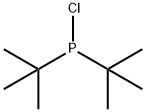
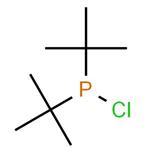
Di-tert-butylchlorophosphine is associated with palladium(II) acetate and used in Suzuki-Miyaura cross-couplings of arylboronic acids with aryl bromides and chlorides. It serves as a ligand and used in the preparation of mono- and bidentate phosphine ligands in metal complexes for catalytic chiral asymmetric hydrogenations. Further, it is used in asymmetric and transition metal coupling reactions. In addition to this, it plays an important role in the preparation of other phosphines in catalytic polymerization reactions.
Uses
Di-tert-butylchlorophosphine is used as a catalyst in organic synthesis.
Application
Bulky ligand used with Pd(OAc)2 in efficient Suzuki-Miyaura cross-couplings of arylboronic acids with aryl bromides and chlorides.
reaction suitability
reagent type: ligand
reaction type: Suzuki-Miyaura Coupling
Synthesis
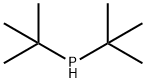
General procedure for the synthesis of di-tert-butylphosphonium chloride from di-tert-butylphosphine: Di-tert-butylphosphine (13.5 g, 92 mmol) was added to a three-necked round-bottomed flask fitted with a thermometer, a charging funnel and a condenser under the protection of nitrogen and heated to 83-84 °C. The synthesis of di-tert-butylphosphonium chloride from di-tert-butylphosphine was carried out by the following procedure. Octyl trichloroacetate (25.4 g, 92 mmol) was slowly added dropwise over a period of 20 minutes. After the dropwise addition, the reaction mixture was continued to be stirred at 70 °C for 20 min, which showed 0.6% unreacted di-tert-butylphosphine by GC analysis. The addition funnel was removed and the short-circuit distillation head was adapted for distillation. Two fractions were collected and the former fraction (1.24 g) was discarded. The second fraction was collected to give 13 g (78.2% yield) of di-tert-butylphosphonium chloride as a clear, colorless liquid with a boiling point of 48-52 °C/3.2 mbar (literature value 48 °C/3 mm Hg). The purity of the product was 97% by GC-FID.
Precautions
Air and moisture sensitive. Keep the container tightly closed in a dry and well-ventilated place. Incompatible with strong oxidizing agents and strong reducing agents.
References
[1] Patent: WO2009/147495, 2009, A2. Location in patent: Page/Page column 17
[2] J. Gen. Chem. USSR (Engl. Transl.), 1991, vol. 61, # 1.1, p. 114 - 118