Preparation
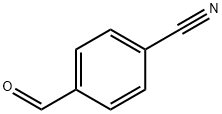
Synthesis steps of 4-cyanobenzaldehyde:
(1) Take 20 mL of p-dimethylbenzene and place it in a reaction vessel. Heat the reaction vessel to 130-135℃ and add the solvent N,N-dimethylformamide DMF, catalyst and co-catalyst in sequence. The amount of N,N-dimethylformamide DMF added is 20-25 mL, and the amount of catalyst and co-catalyst added is 2.5-3.0 g and 10-15 g, respectively. Control the oxygen flow rate to 900 mL/min and the hydrogen flow rate to 100 mL/min. React for 4-5 h; (2) Cool the above reaction solution to room temperature. The obtained transparent colorless crystals are p-methylbenzonitrile. Wash the obtained crystals 2-3 times with DMF and then filter out the impurities. (2) Remove the DMF solvent to obtain p-methylbenzonitrile with a purity higher than 90%; (3) Place the p-methylbenzonitrile synthesized in step (2) above into a reaction vessel, heat the reaction vessel to 110-115℃, and add the solvent N,N-dimethylformamide DMF, catalyst and co-catalyst in sequence. The amount of N,N-dimethylformamide DMF added is 10-15mL, and the amount of catalyst and co-catalyst added is 1.0-1.5g and 8.0-9.0g, respectively. Control the oxygen flow rate to be 900mL/min and the hydrogen flow rate to be 100mL/min. React for 2-3h, and the resulting white crystalline powder is 4-cyanobenzaldehyde.
Chemical Properties
WHITE TO SLIGHTLY BEIGE CRYSTALLINE POWDER
Uses
4-Formylbenzonitrile can be used in the synthesis of various boron-dipyrromethenes (BODIPY), porphyrins, corroles and other related macrocycles.
Uses
4-Cyanobenzaldehyde is used as a reagent in the synthesis of hydrazone based inhibitors of adipose-triglyceride lipase (ATGL). 4-Cyanobenzaldehyde is also used as a reagent in the synthesis of BAZ2-ICR which is a chemical probe targeting the bromo domains of BAZ2A and BAZ2B.
Uses
4-Cyanobenzaldehyde, is used as an intermediate for organic synthesis.It is also used as an intermediate in the pharmaceutical and research department.
Definition
ChEBI: 4-cyanobenzaldehyde is a member of benzaldehydes.