Description
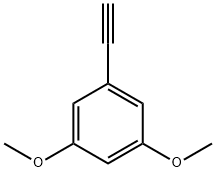
1-ethynyl-3,5-dimethoxybenzene is an organic reagent. Its benzene ring structure contains one acetylene group and two methoxy groups respectively, which are key structures for the synthesis of other heterocyclic compounds.
Synthesis
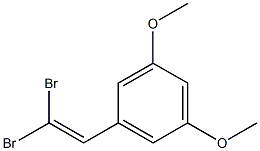
Under argon protection, 1-(2,2-dibromovinyl)-3,5-dimethoxybenzene (2.99 g, 9.28 mmol, 1 eq.) was dissolved in anhydrous tetrahydrofuran (50 mL) and stirred at -50 °C (dry ice/acetonitrile bath). Slowly n-butyllithium (24.0 mL, 1.6 M hexane solution, 38.4 mmol, 4.1 eq.) was added dropwise and the progress of the reaction was monitored by thin-layer chromatography (TLC) until the reaction was complete. The reaction mixture was quenched with saturated aqueous ammonium chloride solution (40 mL) and subsequently extracted with dichloromethane (3 x 20 mL). The organic phases were combined, dried over anhydrous sodium sulfate, filtered and concentrated under reduced pressure to give an orange-brown oil (1.61 g). Purification by fast column chromatography (eluent: pure pentane followed by 19:1 pentane:ether) afforded a colorless crystalline solid 3,5-dimethoxyphenylacetylene (1.22 g, 81% yield) with Rf = 0.24 (pentane) and a melting point of 205 °C. The NMR hydrogen spectrum (400 °F) of 3,5-dimethoxyphenylacetylene was obtained as follows. Its NMR hydrogen spectrum (400.1 MHz, CDCl3) data were as follows: δ 6.72 (d, J = 2.3 Hz, 2H, ArH), 6.50 (t, J = 2.3 Hz, 1H, ArH), 3.76 (s, 6H, OCH3), 3.15 (s, 1H, C≡CH). The NMR carbon spectrum (100.6 MHz, CDCl3) data are as follows: δ 160.6 (C), 123.4 (C), 110.0 (CH), 102.3 (CH), 83.7 (C), 76.9 (CH), 55.4 (CH3).
References
[1] Tetrahedron Letters, 2009, vol. 50, # 17, p. 1969 - 1972
[2] Chemistry Letters, 2008, vol. 37, # 2, p. 174 - 175
[3] Beilstein Journal of Organic Chemistry, 2015, vol. 11, p. 273 - 279
[4] European Journal of Medicinal Chemistry, 2011, vol. 46, # 6, p. 2386 - 2396
[5] Tetrahedron, 2017, vol. 73, # 33, p. 5023 - 5028