Preparation
The synthesis method of 1,1-DIMETHYLBIGUANIDE HYDROCHLORIDE is as follows: (1) Salt formation stage: Dimethylamine aqueous solution is added to a reaction vessel, and hydrochloric acid aqueous solution is added dropwise under low temperature conditions to obtain dimethylamine hydrochloride aqueous solution; (2) Salt distillation stage: Dimethylamine hydrochloride aqueous solution is distilled under reduced pressure to remove water, and dimethylamine hydrochloride solid is obtained; (3) Condensation stage: DMF, toluene and dicyandiamide are added, and the reaction is heated to obtain 1,1-DIMETHYLBIGUANIDE HYDROCHLORIDE. The solution is cooled and filtered to obtain 1,1-DIMETHYLBIGUANIDE HYDROCHLORIDE crystals, and dried to obtain white 1,1-DIMETHYLBIGUANIDE HYDROCHLORIDE.
Uses
Metformin hydrochloride can be used for the following purposes: 1. Type 2 diabetic patients whose condition is not adequately controlled by diet alone (for obese patients and those with hyperinsulinemia, this drug not only lowers blood sugar but also helps reduce weight and alleviate hyperinsulinemia); 2. Certain diabetic patients who respond poorly to sulfonylureas (it can be used in combination with sulfonylureas).
Originator
Diabetex ,Germania
Definition
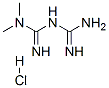
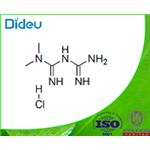
ChEBI: Metformin hydrochloride is a hydrochloride resulting from the reaction of metformin with one molar equivalent of hydrogen chloride. It has a role as an environmental contaminant, a hypoglycemic agent and a xenobiotic. It contains a metformin(1+).
Manufacturing Process
The boiling mixture of 1,000 L xylene, 450 kg dimethylamine and 840 kg dicyanamide was added 365 kg hydrogene chloride. Yield of biguanide, 1,1- dimethyl-, hydrochloride 1,588 kg (96%). Biguanide, 1,1-dimethyl-, hydrochloride may be recrystallysed from methanol.
Therapeutic Function
Oral hypoglycemic