Description
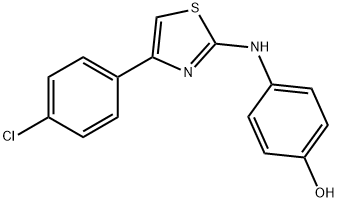
SKI II [2-(p-hydroxyanilino)-4-(p-chlorophenyl)thiazole] is a small-molecule inhibitor originally identified as a selective sphingosine kinase 1 (SK1) inhibitor. Although initially considered to directly inhibit SK1 activity, later studies revealed that its primary mode of action is to induce lysosomal, cathepsin B-dependent degradation of SK1 protein without altering SK1 mRNA expression. As a result, SKI II suppresses cellular SK1 activity mainly by reducing protein abundance through a post-translational mechanism rather than by directly inhibiting enzyme catalysis[3].
Uses
SKI II is a nonlipid inhibitor of sphingosine kinase. SKI II s orally bioavailable and has shown significant inhibition of tumor growth in mice.
Definition
ChEBI: 4-[[4-(4-chlorophenyl)-2-thiazolyl]amino]phenol is a substituted aniline.
Biological Activity
SKI II is a selective non-lipid inhibitor of sphingosine kinase (IC50 = 0.5 μM); does not act at ATP-binding site. Displays no inhibition of ERK2, PI 3-kinase, or PKCα at concentrations up to 60 μM. Reduces levels of sphingosine-1-phosphate in MDA-MB-231 breast cancer cells. Induces apoptosis and inhibits proliferation in several other tumor cell lines in vitro (IC50 = 0.9 - 4.6 μM).
Biochem/physiol Actions
Sphingosine kinase (SK) plays a pivotal role in regulating tumor growth and SK can act as an oncogene. Expression of SK RNA is significantly elevated in a variety of solid tumors, compared with normal tissue from the same patient. A number of novel inhibitors of human SK were identified, and several representative compounds were characterized in detail. These compounds demonstrated activity at sub- to micromolar concentrations, making them more potent than any other reported SK inhibitor, and were selective toward SK compared with a panel of human lipid and protein kinases. Kinetic studies revealed that the compounds were not competitive inhibitors of the ATP-binding site of SK. 4-[4-(4-chloro-phenyl)-thiazol-2-ylamino]-phenol (SKI-II) inhibitor is orally bioavailable, detected in the blood for at least 8 h, and showed a significant inhibition of tumor growth in mice with IC50 = 0.5 μM; SKI II does not act at ATP-binding site. Displays no inhibition of ERK2, PI 3-kinase, or PKCa at concentrations up to 60 μM.SKI II induces apoptosis and inhibits proliferation in several other tumor cell lines in vitro (IC50 = 0.9-4.6 μM).
References
[1] french kj, schrecengost rs, lee bd, zhuang y, smith sn, eberly jl, yun jk, smith cd. discovery and evaluation of inhibitors of human sphingosine kinase. cancer res. 2003 sep 15;63(18):5962-9.
[2] French, Kevin J, et al. “Antitumor Activity of Sphingosine Kinase Inhibitors.”
Journal of Pharmacology and Experimental Therapeutics, 318 2, 2006, pp. 596–603,
https://doi.org/10.1124/jpet.106.101345.[3] Ren, Shuyu, et al. “A Novel Mode of Action of the Putative Sphingosine Kinase Inhibitor 2-(p-Hydroxyanilino)-4-(p-Chlorophenyl) Thiazole (SKI II): Induction of Lysosomal Sphingosine Kinase 1 Degradation.”
Cellular Physiology and Biochemistry, 26 1, 2010, pp. 97–104,
https://doi.org/10.1159/000315110.