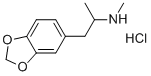
Description
3,4-MDMA (hydrochloride) (CRM) (Item No. ISO60190) is a certified reference material that is structurally categorized as an amphetamine. Also known as ecstasy, it is a euphoric entactogen that is illegal in most countries and is regulated (Schedule I) in the United States. It inhibits transporters for noradrenaline and serotonin (IC
50s = 6.6 and 34.8 μM, respectively) and blocks the uptake of dopamine (IC
50 = 0.48 μM). This neurotoxic compound, unlike typical amphetamines, suppresses locomotor activity in animals at both low and high doses. This product is intended for research and forensic applications.
Chemical Properties
Off-White to Pale Pink Solid
Uses
Entactogen; N-methyl derivative of MDA. (S)-Form possesses more potent CNS activity.
Controlled substance (hallucinogen).
Uses
3,4-Methylenedioxymethamphetamine (MDMA) is an Entactogen; It is the N-methyl derivative of MDA. The (S)-form of MDMA possesses more potent CNS activity than the (R) form of MDMA.
MDMA is controlled substance (hallucinogen).
References
[1] DAVID MICHAEL WOOD. Variability in the 3,4-methylenedioxymethamphetamine content of “ecstasy” tablets in the UK.[J]. Emergency Medicine Journal, 2011, 28 9: 764-765. DOI:
10.1136/emj.2010.092270[2] PATIL ARMENIAN. Multiple MDMA (Ecstasy) overdoses at a rave event: a case series.[J]. Journal of Intensive Care Medicine, 2013, 28 4: 252-258. DOI:
10.1177/0885066612445982[3] MATEUSZ KACPER WONIAK . Application of gas chromatography–tandem mass spectrometry for the determination of amphetamine-type stimulants in blood and urine[J]. Journal of pharmaceutical and biomedical analysis, 2018, 148: Pages 58-64. DOI:
10.1016/j.jpba.2017.09.020