Chemical Properties
light brown crystals or powder
Uses
Hematoxylin and eosin together make up Hematoxylin and eosin stain, one of the most commonly used stains in histology. Metal-haematein complexes are used to stain cell nuclei prior to examination under a microscope. Structures that stain with iron- or aluminum-haematein are often called basophilic, even though the mechanism of the staining is different from that of staining with basic dyes.
Uses
Colorant in inks, biological stains.
Definition
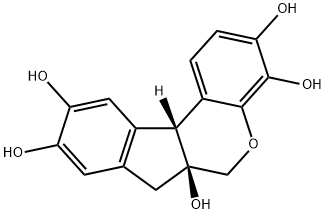
ChEBI: (+)-haematoxylin is a haematoxylin. It is an enantiomer of a (-)-haematoxylin.
General Description
White to yellowish crystals that redden on exposure to light.
Air & Water Reactions
Soluble in hot water, slightly water soluble in cold .
Reactivity Profile
Sensitive to light. .
Hazard
May be carcinogenic.
Biological Activity
Hematoxylin is an organic stain which chelates with metal ions and binds to DNA and RNA. It is used for staining nucleus of the cells. Hematoxylin along with eosin stain is used in the diagnosis of invasion stage in tumors.
Synthesis
Pure hematoxylin is produced by extracting a logwood extract with ether vapor, dissolving the resulting crude hematoxylin in hot water, filtering hot and crystallizing it as colorless needles. For commercial-scale manufacture, the starting material is a powdered logwood extract prepared from a mild aqueous extract of unoxidized logwood chips, which is pressed into briquettes and extracted with ether vapor[1].
Purification Methods
Hematoxylin recrystallises from H2O (as trihydrate) in white-yellow crystals which become red on exposure to light and then melt at 100-120o. It has been recrystallised from Me2CO/*C6H6. It has been recrystallised as well from dilute aqueous NaHSO3 until colourless and is soluble in alkali, borax and glycerol. Store it in the dark below 0o. [Morsingh & Robinson Tetrahedron 26 182 1970, Dann & Hofmann Chem Ber 98 1498 1955, Beilstein 17/8 V 469.]
Description
Hematoxylin is a blue nuclear counterstain for use in immunohistochemical assays. It yields crisp staining detail with superior contrast when used in conjunction with SignalStain
® DAB Substrate Kit
References
[1] Houseman, P. A., & Swift, C. K. (1920). The Preparation of Hematoxylin. Journal of Industrial & Engineering Chemistry, 12(2), 173–174.
https://doi.org/10.1021/ie50122a027