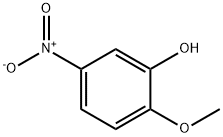
Synthesis
Phenol (0.10 mol) was dissolved in water containing 40% sodium hydroxide (10 mL, 0.1 mol) and heated to allow it to dissolve slowly. The water was then concentrated by evaporation under reduced pressure. PEG 400 (1.6 g, approximately 0.04 mol) and the alkylating agent dimethyl sulfate (0.11 mol) were slowly added to the reaction system with vigorous stirring. The reaction was accelerated by heating and monitored by HPLC and TLC until the phenol was completely converted. The mixture was then poured into a hot aqueous solution of sodium hydroxide (5%) or water (80-90°C, 100 mL) and stirred to allow the product to precipitate or separate into layers. The precipitate or organic layer was washed with water (three times, 50 mL each time). HPLC showed that the purity of the product obtained via this route was above 96%. For higher purity, recrystallization with a suitable solvent or distillation under vacuum can be performed. Caution: Dimethyl sulfate is a highly toxic compound; extreme caution must be exercised during handling. It must never come into contact with skin or gloves.

Chemical Properties
Yellow to light brown powder
Uses
2-Methoxy-5-nitrophenol is used in the synthesis of potent VEGF and tyrosine kinase inhibitors. Also used in the synthesis of GABA analogues and phosphodiesterase inhibitors such as rolipram.
Definition
ChEBI: 2-Methoxy-5-nitrophenol is a member of 3-nitrophenols.
Synthesis Reference(s)
Chemical and Pharmaceutical Bulletin, 28, p. 1287, 1980
DOI: 10.1248/cpb.28.1287
General Description
2-Methoxy-5-nitrophenol is the substitution photoproduct formed on irradiation of 2-chloro-4-nitroanisole at 25°C in aqueous NaOH.