Preparation
Add 20g water and 50g erythromycin thiocyanate to 140g acetone, heat to 35-38℃, stir for 5 minutes, add 9g triethylamine to desulfurize erythromycin thiocyanate to free erythromycin base, and the system is clear;
Add 13.5g propionic anhydride at 35-38℃, react for 120 minutes to generate erythromycin propionate; filter;
Add dodecyl sulfate solution (dodecyl sulfate solution) then.
The dodecyl sulfate solution was prepared as follows: dodecyl sulfate:water = 17g:90g. The reaction was maintained at this temperature for 60 minutes to generate erythromycin. 50g of water was added at 35-38℃ to make the solution turbid, and the mixture was stirred for 60 minutes to precipitate a large amount of erythromycin. 500g of water was added, and the temperature was lowered to 5-10℃ for crystallization. After centrifugation, the filter cake was washed with water and dried to obtain 61g of erythromycin. The yield was 61/50 = 122%. The product produced using the above process is a white crystalline powder; almost odorless, with a melting point of 132-138℃, readily soluble in ethanol or chloroform, and almost insoluble in water. Elemental analysis showed that the elemental values were close to the theoretical values.
Description
Erythromycin estolate was synthesized by the Lilly Research Laboratories in 1959. It shows a higher and longer lasting serum level than erythromycin and the other esters, ethylsuccinate and stearate, when administered orally. This antibiotic is stable against gastric acids, and after oral absorption it is hydrolyzed gradually into erythromycin. Long-term usage of erythromycin estolate is toxic to the liver. Erythromycin ethylsuccinate [41342-53-4], (C43H75NO16, Mr 862.07) and erythromycin stearate [643-22-1] (C37H67NO13 · C18H36O2, Mr 1018.43) also have been used orally, and erythromycin lactobionate [3847-29-8] (C37H67NO13 · C12H22NO12, Mr 1092.25) has been used by intravenous administration and opthalmic topical application
Chemical Properties
Long Needles
Originator
Ilosone,Dista,US,1958
Uses
Used as an antibacterial agent. LD50 >5000 mg/kg for oral administration to rats.
Uses
Macrolides Antibiotics
Definition
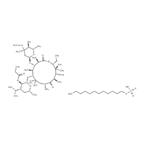
ChEBI: Erythromycin estolate is an aminoglycoside sulfate salt and an erythromycin derivative. It has a role as an enzyme inhibitor. It contains an erythromycin A 2'-propanoate.
Manufacturing Process
16.7 grams of monopropionylerythromycin are dissolved in 50 ml of warm
acetone. To the solution are added 6.4 grams of sodium lauryl sulfate
dissolved in 50 ml of distilled water containing 2 ml of glacial acetic acid. The
white crystalline precipitate of rnonopropionylerythromycin lauryl sulfate which
separates is filtered off and dried. It melts at about 135° to 137°C.
brand name
Antibio-aberel;Apo-erythro-s;Bio-exazol;Biometran;Biomicron;Chemthromycin;Cimetrin;Cusimicina balsamica;Doboiosol;Dowmicyn;Dreimicina;Duozplin vitaminado;Dynabiotal;Ees-200;Ees-400;E-mycine;Endoeritrina;Erimec;Erirobios;Eritrazol;Eritrobios;Eritrobiotic;Eritrocin;Eritrodes;Eritronicol;Eritropan;Eritroveinte;Eritrovienite;Eritrowolf;Eritro-wolf;Erymycin;Eryped;Ery-tar;Erythromictine;Erythro-prat;Ery-toxinal;Erytrodol;Erytro-prot;Eryt-toxinal;Espimina;Estimina;Estomiicina;Estomycin;Fesmicina;Ilosone pulvules;Ilosone ready-mix;Ilothycin;Kesso-mycin;Laucetin;Laurilin;Lauritran;Liferitrin;Loderm;Lubomycina;Lubomycine;Makrocyklina;Manilina;Marocid;Neo-ilolycina;Neo-iloticina;Niux;Novorythro;Propriocin enfante;Prospiocine;Proterytrin;Pulmomas;Purmycin;Ritromin;Roxo chemil;Roxochemil;Rp-mycin;Rubibacter;Selvicin;Spetrasone;Stella micina;Taimoxin;Togerin;Togrien;Tosinova;Tropoxin;Wyamycin s.
Therapeutic Function
Antibacterial
World Health Organization (WHO)
Erythromycin estolate, a macrolide antibiotic, was introduced in
1958 for the treatment of gram-positive infections. By the early 1970s its use had
been associated with a higher incidence of hepatic toxicity than that seen with
other salts and esters of erythromycin. This led to its withdrawal by some
regulatory authorities whereas others required the addition of a warning in the
product information. Evidence that the estolate ester is more hepatotoxic than
other salts or esters has subsequently been disputed. It has been claimed to be the most effective ester for treatment of Legionnaire's disease and preparations remain
widely available.
(Reference: (BMJOAE) British Medical Journal, 286, 1954, 1983)
General Description
Erythromycin estolate, erythromycin propionate lauryl sulfate(Ilosone), is the lauryl sulfate salt of the 2'-propionateester of erythromycin. Erythromycin estolate is acid stableand absorbed as the propionate ester. The ester undergoesslow hydrolysis in vivo. Only the free base binds to bacterialribosomes. Some evidence, however, suggests that theester is taken up by bacterial cells more rapidly than thefree base and undergoes hydrolysis by bacterial esteraseswithin the cells. The incidence of cholestatic hepatitis is reportedlyhigher with the estolate than with other erythromycinpreparations.
Erythromycin estolate occurs as long needles that aresparingly soluble in water but soluble in organic solvents. administration for the treatment of serious infections,such as Legionnaires disease, or when oral administrationis not possible. Solutions are stable for 1 week whenrefrigerated.