Chemical Properties
off-white to brown powder
Uses
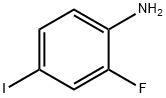
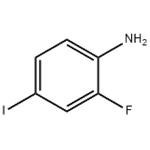
2-Fluoro-4-iodoaniline is widely used in the pharmaceutical, chemical and food industries as a fundamental building block to create a variety of important compounds.
General Description
The profiling of iodine-containing metabolites produced by the earthworm
Eisenia veneta by exposing it to 2-fluoro-4-iodoaniline was carried out using high-performance liquid chromatography/inductively coupled plasma mass spectrometry (HPLC/ICPMS).
Synthesis
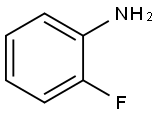
The general procedure for the synthesis of 2-fluoro-4-iodoaniline from o-fluoroaniline is as follows: o-fluoroaniline (54 g, 486 mmol) was added to an aqueous solution (250 mL) of sodium bicarbonate (41 g, 486 mmol) with vigorous stirring. The suspension was heated to 60 °C in an oil bath and iodine (123 g, 486 mmol) was added in batches. After addition, the dark-colored mixture was continued to be stirred at 60°C for 3 hours. After completion of the reaction, it was cooled to room temperature and dichloromethane (300 mL) was added, followed by saturated sodium bisulfite solution (300 mL). The two-phase system was stirred vigorously for 10 minutes. The mixture was transferred to a 2L separatory funnel and the organic layer was separated. The aqueous layer was further extracted with dichloromethane (3 x 200 mL) and the combined organic phases were washed with brine (200 mL) and dried over anhydrous sodium sulfate. After filtration, the solvent was removed under reduced pressure to give a black crystalline solid. Hexane (300 mL) was added to the solid and the mixture was heated to reflux. A hexane solution was poured from the black insoluble syrup. Upon cooling, the product crystallized from hexane as fine yellow needles. Final isolation afforded 65 g (274 mmol) of 2-fluoro-4-iodoaniline as a fine yellow solid in 56% yield with a melting point of 53°C. 1H NMR (400 MHz, CDCl3) δ 8.1 (t, J=8Hz, 1H), 7.4 (d, J=6Hz, 1H), 7.2 (d, J=6Hz, 1H).
References
[1] Journal of the Chemical Society. Perkin Transactions 2, 1999, # 3, p. 481 - 491
[2] Arzneimittel-Forschung/Drug Research, 1984, vol. 34, # 11 A, p. 1612 - 1624
[3] Journal of Organic Chemistry, 2005, vol. 70, # 7, p. 2870 - 2873
[4] Patent: WO2004/41793, 2004, A1. Location in patent: Page 141
[5] Chemical Communications, 2014, vol. 50, # 17, p. 2136 - 2138