Description
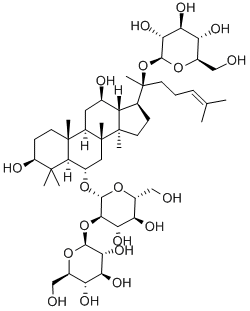
Ginsenosides are pharmacologically active natural constituents of ginseng and other plants of the genus
Panax. Structurally, they are steroid glycosides derived from the triterpene squalene. Ginsenoside Rd is a protopanaxadiol which is more abundant in some
Panax species (
e.g., P. quinquefolium) than others. This ginsenoside has diverse
in vitro and
in vivo effects, including cardioprotective, neuroprotective, and anti-
inflammatory actions. Notably, ginsenoside Rd is converted to other ginsenosides in response to steaming or heating plant materials, leading to loss of these activities.
Chemical Properties
White to off-white crystals powder
Uses
Ginsenoside RD has been shown to attenuate tau protein phosphorylation via the PI3K/AKT/GSK-3β pathway after forebrain ischemia. This could be used to counter the risk of developing post-stroke dementia.
Definition
ChEBI: Ginsenoside Rd is a ginsenoside found in Panax ginseng and Panax japonicus var. major that is (20S)-ginsenoside Rg3 in which the hydroxy group at position 20 has been converted to its beta-D-glucopyranoside. It has a role as a vulnerary, a neuroprotective agent, an apoptosis inducer, an anti-inflammatory drug, an immunosuppressive agent and a plant metabolite. It is a ginsenoside, a beta-D-glucoside and a tetracyclic triterpenoid. It is functionally related to a (20S)-ginsenoside Rg3.
in vivo
Ginsenosides Rd is a major compound isolated from Gynostemma pentaphyllum that holistically improves gut microenvironment and induces anti-polyposis in ApcMin/+ mice. Six-weeks-old mice are subjected to Ginsenoside Rd treatment, before the appearance of the intestinal polyps. All the mice are monitored for food intake, water consumption, and weight changes. Throughout the experiment, no Rb3/ Ginsenoside Rd-associated weight loss in mice is observed. In addition, none of the treated mice show variations in food and water consumption. Whereas, the number and size of the polyps are effectively reduced by Ginsenoside Rd treatments[3].
IC 50
NF-κB: 12.05 μM (IC
50, in HepG2 cells); COX-2; L-type calcium channel; CYP2D6: 58 μM (IC
50); CYP1A2: 78.4 μM (IC
50); CYP3A4: 81.7 μM (IC
50); CYP2C9: 85.1 μM (IC
50)
References
[1] CHIEH-FU CHEN Jun tian Z Wen fei Chiou. Comparison of the pharmacological effects of Panax ginseng and Panax quinquefolium[J]. Acta Pharmacologica Sinica, 2008, 29 9: 1103-1108. DOI:
10.1111/j.1745-7254.2008.00868.x[2] YANG WANG. Ginsenoside Rd attenuates myocardial ischemia/reperfusion injury via Akt/GSK-3β signaling and inhibition of the mitochondria-dependent apoptotic pathway.[J]. PLoS ONE, 2013: e70956. DOI:
10.1371/journal.pone.0070956[3] X. LIU. Ginsenoside-Rd improves outcome of acute ischaemic stroke – a randomized, double-blind, placebo-controlled, multicenter trial[J]. European Journal of Neurology, 2012, 19 6: 855-863. DOI:
10.1111/j.1468-1331.2011.03634.x[4] SEOK BEAN SONG. Inhibition of TNF-α-mediated NF-κB Transcriptional Activity in HepG2 Cells by Dammarane-type Saponins from Panax ginseng Leaves.[J]. Journal of Ginseng Research, 2012, 36 2: 146-152. DOI:
10.5142/jgr.2012.36.2.146