Description
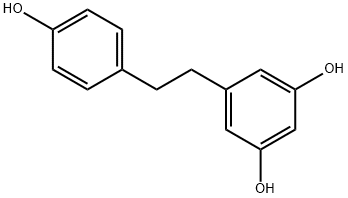
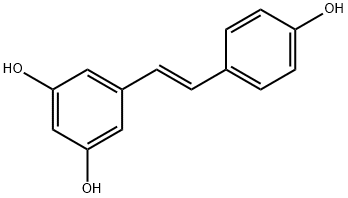
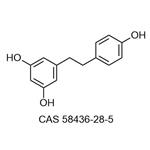
Dihydroresveratrol (58436-28-5) is a metabolite of resveratrol produced by gut microbiota.1-3Glucoronide conjugates are found in human urine after oral intake of resveratrol-containing dietary supplements.4Dihydroresveratrol glucoside is a potent melanogenesis inhibitor in B16F0 melanoma cells.5Inactive analog of resveratrol in induction of premature senescence.6
Uses
Dihydroresveratrol is a major metabolite of resveratrol that is produced by animal-associated bacteria, including the gut microbiota. Dihydroresveratrol and dihydroresveratrol monosulfate are detectable in urine. The physiological effects of dihydroresveratrol have not been investigated.
Definition
ChEBI: Dihydroresveratrol is a stilbenol that is 1,1'-ethane-1,2-diyldibenzene with hydroxy groups at positions 1, 3 and 4'. It has a role as a xenobiotic metabolite and a plant metabolite.
References
[1] CARINA M. JUNG. Interaction of dietary resveratrol with animal-associated bacteria[J]. Fems Microbiology Letters, 2009, 297 2: 266-273. DOI:
10.1111/j.1574-6968.2009.01691.x[2] LISA M BODE. In vivo and in vitro metabolism of trans-resveratrol by human gut microbiota123[J]. American Journal of Clinical Nutrition, 2013, 97 2: Pages 295-309. DOI:
10.3945/ajcn.112.049379[3] VERONIKA JAROSOVA. Metabolism of Stilbenoids by Human Faecal Microbiota.[J]. Molecules, 2019, 24 6. DOI:
10.3390/molecules24061155[4] YULIA RADKO Lars P C Kathrine B Christensen. Semi-preparative isolation of dihydroresveratrol-3-O-β-d-glucuronide and four resveratrol conjugates from human urine after oral intake of a resveratrol-containing dietary supplement[J]. Journal of Chromatography B, 2013, 930: Pages 54-61. DOI:
10.1016/j.jchromb.2013.05.002[5] CHISATO OODE . Synthesis of dihydroresveratrol glycosides and evaluation of their activity against melanogenesis in B16F0 melanoma cells[J]. European Journal of Medicinal Chemistry, 2014, 87: Pages 862-867. DOI:
10.1016/j.ejmech.2014.09.092[6] RICHARD G A FARAGHER. Resveratrol, but not dihydroresveratrol, induces premature senescence in primary human fibroblasts.[J]. AGE, 2011, 33 4: 555-564. DOI:
10.1007/s11357-010-9201-5