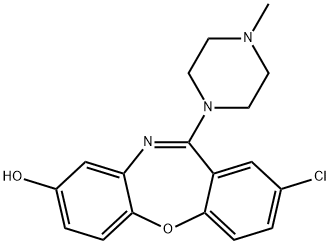
Description
8-hydroxy Loxapine (8-OH loxapine) is a metabolite formed when loxapine , an atypical antipsychotic, is metabolized by the cytochrome P450 isoform CYP1A2. Loxapine displays high affinity for histamine, serotonin (5-HT), dopamine, and α
1-adrenergic receptors (K
i values = 7, 7.7, 9.5, 12, and 31 nM for H
1, 5-HT
2A, 5-HT
2C, D
2, and α
1A-adrenergic receptors, respectively). It reduces agitation associated with schizophrenia or bipolar disorder. 8-OH Loxapine is considered inactive as it has relatively low affinity to dopamine and 5-HT receptors compared to the parent compound, however, 8-OH loxapine inhibits [
14C]5-HT uptake
in vitro (IC
50 = 2 μM in human platelets).
References
[1] MD P S, PH.D Hubert H M V T Ph D Roy Corbett Ph D. Atypical Neuroleptics Have Low Affinity for Dopamine D2 Receptors or Are Selective for D4 Receptors[J]. Neuropsychopharmacology, 1997, 16 2: 93-110. DOI:
10.1016/s0893-133x(96)00187-x[2] YIN CHEONG WONG Zhong Z Siu Kwan Wo. Investigation of the disposition of loxapine, amoxapine and their hydroxylated metabolites in different brain regions, CSF and plasma of rat by LC–MS/MS[J]. Journal of pharmaceutical and biomedical analysis, 2012, 58: Pages 83-93. DOI:
10.1016/j.jpba.2011.09.020[3] ANDREW J GOUDIE. H1-histamine Receptor Affinity Predicts Short-term Weight Gain for Typical and Atypical Antipsychotic Drugs[J]. Neuropsychopharmacology, 2003, 28 12: 2209-2209. DOI:
10.1038/sj.npp.1300291[4] JUSTIN FADEN L C. Examining the safety, efficacy, and patient acceptability of inhaled loxapine for the acute treatment of agitation associated with schizophrenia or bipolar I disorder in adults[J]. Neuropsychiatric Disease and Treatment, 2019, 15 1: 2273-2283. DOI:
10.2147/ndt.s173567[5] A. FULTON G. D B T Norman. Ligand binding and platelet uptake studies of loxapine, amoxapine and their 8-hydroxylated derivatives[J]. Journal of affective disorders, 1982, 4 2: Pages 113-119. DOI:
10.1016/0165-0327(82)90041-6