Chemical Properties
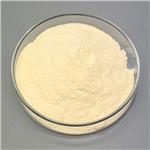
White powder
Uses
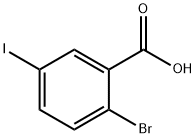
2-Bromo-5-iodobenzoic acid serves as the starting material for 4-bromo-[1,1'-biphenyl]-3-carboxylic acid in a Suzuki-Miyaura reaction with boronic acid, in which the palladium catalyst first inserts into the iodine-carbon bond and a base such as K2CO3 activates the boronic acid for phenyl addition[3]. It is also converted to tert-butyl 2-bromo-5-iodobenzoate by treatment with 1,1-di-tert-butoxytrimethylamine in toluene at 80 °C under nitrogen[4]. With 2-iodopropane and potassium carbonate in DMF at room temperature, it gives isopropyl 2-bromo-5-cyanobenzoate[4].
Synthesis
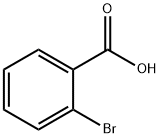
The general procedure for the synthesis of 2-bromo-5-iodobenzoic acid from o-bromobenzoic acid was as follows: Concentrated sulfuric acid (294.4 g) was added to the reaction flask and the temperature of the reaction system was lowered to 5-10 °C. Subsequently, o-bromobenzoic acid (126.9 g, 0.456 mol) and dichloromethane (687 g) were added. The reaction system was warmed to 15-20 °C and 1,3-diiodo-5,5-dimethyl-acetylurea (total 126.9 g, 0.25 mol, prepared according to Example 1) was added in 4 batches. After 2 hours of reaction at 15-20°C, the reaction solution was slowly poured into ice water (686.9 g) and the reactor temperature was controlled at 15-25°C. Next, 45.8 g ester kettle was added followed by methyl tertiary butyl ether (MTBE, 800 g) and the mixture was stirred for extraction for 20 min. After standing and stratifying, the upper organic phase was separated and collected. The aqueous phase was extracted one more time with MTBE (458 g) and after stirring for 20 min, the layers were separated and the upper organic phase was collected. All the organic phases were combined, kept at 15-25 °C, and treated by adding 5% aqueous sodium sulfite (126.04 g) for 30 min, and after layering, the organic phase was evaporated to dryness at 60 °C under atmospheric pressure. Subsequently, the MTBE in the residue was completely evaporated. Under reduced pressure, toluene (458 g) was added and the temperature of the system was raised to 95 °C to dissolve all substances. It was cooled to 18-22 °C and filtered and the filter cake was washed with toluene. Finally, it was dried at 50-55 °C under vacuum (-0.095 MPa) to give 109.4 g of off-white solid product with ≥98% purity and 73.5% yield.
References
[1] Patent: CN107954861, 2018, A. Location in patent: Paragraph 0094; 0095
[2] Tetrahedron, 2015, vol. 71, # 2, p. 283 - 292
[3] Synthesis and Optimization of Di-Substituted Acridine Photo-organocatalysts
[4] Seto, M., Masada, S., Usutani, H., Cork, D. G., Fukuda, K., & Kawamoto, T. (2019). Application of Continuous Flow-Flash Chemistry to Scale-up Synthesis of 5-Cyano-2-formylbenzoic Acid. Organic Process Research & Development, 23(7), 1420–1428.
https://doi.org/10.1021/acs.oprd.9b00180