Chemical Properties
Crystalline
Uses
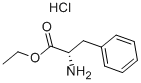
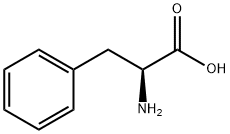
L-Phenylalanine Ethyl Ester Hydrochloride is an derivative of L-Phenylalanine (P319415), an essential amino acid.
reaction suitability
reaction type: solution phase peptide synthesis
Synthesis
1. L-phenylalanine (5 g, 30 mmol) was dissolved in anhydrous ethanol (30 mL).
2. slowly add trimethylchlorosilane (TMSCl, 6.915 mL, 54 mmol) to the reaction system at room temperature.
3. A reflux condenser was assembled and the reaction system was heated in an oil bath at 80 °C. 4.
4. The reaction mixture was allowed to react overnight under stirring conditions.
5. On the following day, the reaction system was cooled to room temperature and the reaction solution was subsequently concentrated under reduced pressure. 6.
6. The concentrated residue was dissolved in ether (Et2O).
7. The resulting slurry was filtered and the separated solid product was further washed with ether.
8. The washed solid was dried under high vacuum to afford the target product (S)-ethyl 2-amino-3-phenylpropionate hydrochloride (6.86 g, 99% yield). 9. The structure of the product was confirmed by 1H NPD analysis.
9. The structure of the product was confirmed by 1H NMR (400 MHz, DMSO-d6): δ8.52 (s, 3H), 7.30 (m, 5H), 4.24 (ABX, JAX=7.8 Hz, JBX=6.2 Hz, 1H), 4.11 (m, 2H), 3.17, 3.05 (ABX, JAB=-14 Hz, JBX=5.8 Hz, JAX=7.6 Hz, 2H), 1.09 (t, J=6.8 Hz, 3H).
References
[1] Patent: US2017/71964, 2017, A1. Location in patent: Paragraph 0594-0595
[2] Indian Journal of Chemistry - Section B Organic and Medicinal Chemistry, 2006, vol. 45, # 8, p. 1942 - 1944
[3] Tetrahedron Letters, 2015, vol. 56, # 49, p. 6900 - 6903
[4] Chemical Communications, 2011, vol. 47, # 42, p. 11784 - 11786
[5] Recueil des Travaux Chimiques des Pays-Bas, 1990, vol. 109, # 7/8, p. 413 - 418